
Select the word-pair that best represents a similar relationship to the one expressed in the given pair of words. (The words must be considered as meaningful English words and must not be related to each other based on the number of letters/number of consonants/vowels in the word) Money plant : Climber
Rose : Shrub
Understanding Word Analogies: Money Plant and Climber
Word analogies require you to find the relationship between a given pair of words and then select another pair from the options that shares the most similar relationship. The given pair is "Money plant : Climber".
Analyzing the Given Word Pair: Money Plant : Climber
Let's break down the relationship between 'Money plant' and 'Climber'.
- A Money plant is a specific type of plant.
- A Climber describes the growth habit or type of plant.
So, the relationship is: Specific type of plant : Classification/Growth Habit. A Money plant is classified as a climber because it grows by climbing or twining around a support.
Evaluating the Options
Now, let's examine each option to see which one exhibits a similar relationship.
Option 1: Rose : Shrub
- A Rose is a specific type of plant.
- A Shrub is a classification describing a woody plant, typically smaller than a tree, with multiple stems arising near the ground.
This pair represents the relationship: Specific type of plant : Classification/Growth Habit. A Rose is classified as a shrub.
This relationship appears to be very similar to the original pair (Money plant : Climber).
Option 2: Peas : Green
- Peas are a specific type of plant (or seed from a plant).
- Green is a color.
This pair represents the relationship: Specific type of plant : Characteristic (Color). The relationship is about a characteristic of the plant, not its classification or growth habit.
This relationship is different from the original pair.
Option 3: Basil : Tree
- Basil is a specific type of plant (a herb).
- A Tree is a classification describing a large woody plant, usually with a single trunk.
This pair represents the relationship: Specific type of plant : Classification. However, Basil is typically a small herb, not a tree. While 'Tree' is a classification, it is an incorrect classification for Basil. The analogy requires a correct and meaningful relationship.
This relationship is not similar because the classification provided is incorrect for the plant.
Option 4: Banyan : Roots
- A Banyan is a specific type of plant (a tree).
- Roots are parts of the plant that typically grow underground.
This pair represents the relationship: Specific type of plant : Part of the plant. The relationship is about a component of the plant, not its classification or growth habit.
This relationship is different from the original pair.
Conclusion
Comparing the relationships:
- Money plant : Climber (Specific Plant : Classification/Growth Habit)
- Rose : Shrub (Specific Plant : Classification/Growth Habit)
- Peas : Green (Specific Plant : Characteristic)
- Basil : Tree (Specific Plant : Incorrect Classification)
- Banyan : Roots (Specific Plant : Part)
The pair "Rose : Shrub" demonstrates the most similar relationship to "Money plant : Climber", both representing a specific plant and its general classification or growth form.
| Pair | Relationship Type |
|---|---|
| Money plant : Climber | Specific Plant : Classification/Growth Habit |
| Rose : Shrub | Specific Plant : Classification/Growth Habit |
| Peas : Green | Specific Plant : Characteristic |
| Basil : Tree | Specific Plant : Incorrect Classification |
| Banyan : Roots | Specific Plant : Part |
Revision Table: Plant Classifications and Growth Habits
Here's a quick overview of some common plant classifications based on their structure and growth habit:
| Classification | Description | Examples |
|---|---|---|
| Tree | Large, woody plant usually with a single trunk and crown. | Oak, Maple, Banyan |
| Shrub | Woody plant, smaller than a tree, typically with multiple stems from the base. | Rose, Lilac, Forsythia |
| Herb | Non-woody plant, often with soft stems. | Basil, Mint, Parsley |
| Climber (or Vine) | Plant that grows upwards by clinging or twining. | Money plant, Ivy, Grapevine |
| Creeper | Plant that grows along the ground. | Strawberry, Pumpkin vine |
Additional Information: Solving Word Analogies
Successfully solving word analogies involves identifying the precise relationship between the first pair of words. Here are some common types of relationships found in analogies:
- Part to Whole: e.g., Finger : Hand (Finger is part of a Hand)
- Cause and Effect: e.g., Study : Pass (Studying can cause you to Pass)
- Synonyms: e.g., Happy : Joyful (Words with similar meanings)
- Antonyms: e.g., Hot : Cold (Words with opposite meanings)
- Worker and Tool: e.g., Carpenter : Saw (Carpenter uses a Saw)
- Action and Object: e.g., Read : Book (You read a Book)
- Classification/Type: e.g., Dog : Mammal (Dog is a type of Mammal)
- Specific to General: e.g., Apple : Fruit (Apple is a specific type of Fruit)
- Location: e.g., Bird : Nest (Bird lives in a Nest)
- Degree: e.g., Warm : Hot (Hot is a greater degree of Warm)
Once you identify the relationship, test it against each option to find the pair that shares the exact same or the most similar relationship.
Similar Questions
Which two numbers and two signs should be interchanged to make the given equation correct?
5 + 44 - 8 × 25 = 203
Select the set in which the numbers are related in the same way as are the numbers of the following set.
(NOTE: Operations should be performed on the whole numbers, without breaking down the numbers into its constituent digits.)
(60, 5, 6)
(48, 8, 3)
A & B means ‘A is the son of B’
A # B means ‘A is the sister of B’
A @ B means ‘A is the brother of B’
A % B means ‘A is the father of B’
A - B means ‘A is the daughter of B’
A * B means ‘A is the wife of B’
If C # D @ E % Z & L # M - N * P, then how is Z related to N?
Select the set in which the numbers are related in the same way as are the numbers of the following sets.
(NOTE : Operations should be performed on the whole numbers, without breaking down the numbers into its constituent digits. E.g. 13 - Operations on 13 such as adding / subtracting / multiplying etc. to 13 can be performed. Breaking down 13 into 1 and 3 and then performing mathematical operations on 1 and 3 is not allowed)
(144, 9, 3)
(225, 7, 8)
Select the figure that will come next in the following figure series.

Select the figure from among the given options that can replace the question mark (?) in the following series.

Read the given statements and conclusions carefully. Assuming that the information given in the statements is true, even if it appears to be at variance with commonly known facts, decide which of the given conclusions logically follow(s) from the statements.
Statements:
All pens are plates.
All plates are trays.
Some trays are boxes.
Conclusions:
I. Some boxes are plates.
II. Some trays are pens.
III. Some boxes are pens.
IV. No tray is a plate.
In the following question, select the missing number from the given series.
69, 70, 73, 78, 85, ?
If A × B means that A is the father of B, A + B means that A is the mother of B, A ÷ B means that A is the brother of B then which of the following expression shows that A is the paternal uncle of C?
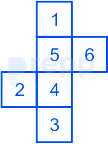
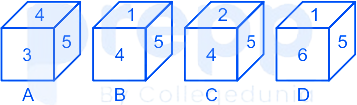
Select the cube that can be formed by folding the given sheet along the lines.
Important Questions from Miscellaneous
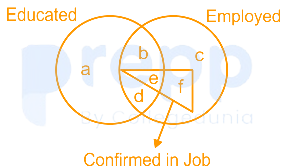
Read the given figure and find the region representing persons who are educated and employed but not confirmed in job.
The magazine in which Mahatma Gandhi mentioned what he wanted the Constitution to do is:
Which gas shields the surface of the earth from ultraviolet radiation from the sun?
Which event is marked as an Intangible Cultural Heritage of Humanity by UNESCO?
Who has been conferred with the rank of the Commander of the Order of the British Empire in 2018?



