Secondary Aerosols Defined
Secondary aerosols are microscopic particles that form in the atmosphere through chemical reactions involving precursor gases.
Formation Process
These gases undergo transformation processes, such as oxidation, leading to the formation of new, less volatile compounds. These compounds then condense or nucleate to form new particles or grow existing ones.
Distinction from Primary Aerosols
Unlike primary aerosols, which are emitted directly into the atmosphere in particulate form (like dust or sea salt), secondary aerosols are formed in situ.
Analysis of Options
- Option 1 & 2: Dust emissions and sea particulates represent primary aerosols, directly released into the air.
- Option 3: This option accurately describes the formation process of secondary aerosols from gaseous substances present in the air.
- Option 4: Black carbon is often a component of primary aerosols (emitted from combustion) but can also be involved in secondary processes; however, the core definition of secondary aerosols lies in their formation from gases.
Conclusion
Therefore, secondary aerosols are specifically particles formed in the air from gaseous substances.
Similar Questions
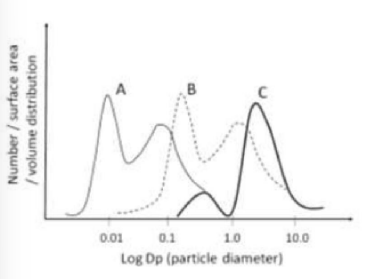
In the above figure, the curves A, B and C denote____, ____ and ____ distributions, respectively.
- The mixing ratio of water vapour in the Earth's atmosphere is approximately
- Oxygenation of the Earth's atmosphere was caused by
- The coldest part of the Earth's atmosphere is
Important Questions from Principles Of Stratigraphy
- Which one of the following molecules is the most buoyant in the atmosphere?
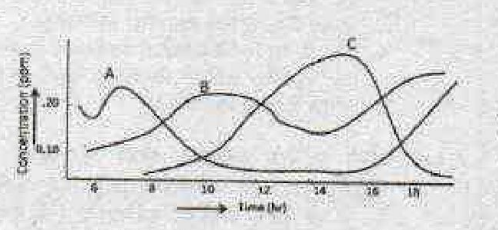
In the above diagram, A, B and C represent, respectively, the tropospheric concentrations of
- Oxygen atom required to form tropospheric ozone comes from
- Atmospheric layers where convection takes place are
Radiocarbon, used for dating sediments, is produced at the top of the Earth's atmosphere by the