
Radiocarbon, used for dating sediments, is produced at the top of the Earth's atmosphere by the
reaction of secondary neutrons with atmospheric nitrogen
Radiocarbon Production Mechanism
Radiocarbon, specifically Carbon-14 ($^{14}$C), is a crucial isotope used in dating ancient organic materials and sediments. Its formation occurs in the Earth's upper atmosphere.
Cosmic Ray Interaction and Neutron Production
The process begins with primary cosmic rays entering the atmosphere. These high-energy particles collide with atomic nuclei in the atmosphere, creating a cascade of secondary particles, including neutrons.
Formation of Carbon-14
The direct production of radiocarbon involves these secondary neutrons. When a secondary neutron interacts with an atom of atmospheric nitrogen-14 ($^{14}$N), a nuclear reaction takes place.
This reaction yields a Carbon-14 ($^{14}$C) atom and a proton (p). The specific nuclear equation is:
$ ^{14}\text{N} + \text{n} \rightarrow ^{14}\text{C} + \text{p} $
This confirms that the reaction of secondary neutrons with atmospheric nitrogen is the source of radiocarbon.
Important Questions from Principles Of Stratigraphy
- Which one of the following molecules is the most buoyant in the atmosphere?
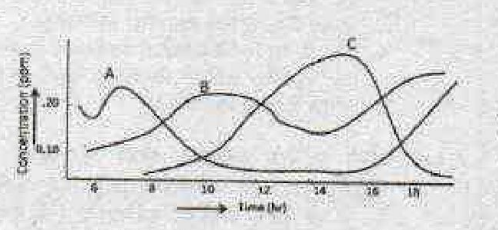
In the above diagram, A, B and C represent, respectively, the tropospheric concentrations of
- Oxygen atom required to form tropospheric ozone comes from
- Atmospheric layers where convection takes place are
Which of the following rare gases is the most abundant in the Earth's atmosphere?


