
Buoyancy Explained
Buoyancy is the tendency for an object to float in a fluid (like the atmosphere). It depends on the object's density compared to the fluid's density. An object less dense than the fluid will rise (be buoyant).
For gases in the atmosphere, density is primarily determined by molar mass. Lighter gases (lower molar mass) are less dense and thus more buoyant.
Molar Mass Calculation
Let's calculate the approximate molar masses of the given molecules using atomic masses (H≈1, C≈12, N≈14, O≈16 g/mol):
- $\text{CO}_2$: $12.01 + (2 \times 16.00) = 44.01 \text{ g/mol}$
- $\text{H}_2\text{O}$: $(2 \times 1.01) + 16.00 = 18.02 \text{ g/mol}$
- $\text{N}_2\text{O}$: $(2 \times 14.01) + 16.00 = 44.02 \text{ g/mol}$
- $\text{O}_3$: $3 \times 16.00 = 48.00 \text{ g/mol}$
Comparing Buoyancy
The Earth's atmosphere is mostly nitrogen ($\text{N}_2$, ~28 g/mol) and oxygen ($\text{O}_2$, ~32 g/mol), with an average molar mass around 29 g/mol.
We need the molecule with the lowest molar mass to be the most buoyant:
- $\text{H}_2\text{O}$ (18.02 g/mol) is significantly less dense than the atmosphere.
- $\text{CO}_2$ (44.01 g/mol), $\text{N}_2\text{O}$ (44.02 g/mol), and $\text{O}_3$ (48.00 g/mol) are all denser than the atmosphere.
Therefore, $\text{H}_2\text{O}$ is the most buoyant molecule among the choices.
Important Questions from Principles Of Stratigraphy
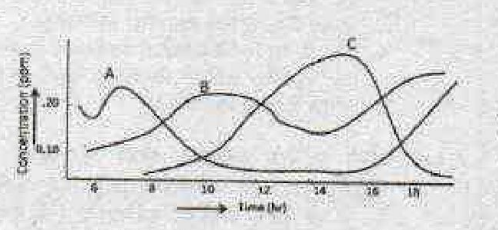
In the above diagram, A, B and C represent, respectively, the tropospheric concentrations of
- Oxygen atom required to form tropospheric ozone comes from
- Atmospheric layers where convection takes place are
Radiocarbon, used for dating sediments, is produced at the top of the Earth's atmosphere by the
Which of the following rare gases is the most abundant in the Earth's atmosphere?


