
Read the given statement(s) and conclusions carefully. Assuming that the information given in the statements is true, even if it appears to be at variance with commonly known facts, decide which of the given conclusions logically follow(s) from the statement(s). Statements: Some floors are plates. No plate is a sofa. All gardens are plates. Conclusions: I. Some floors being gardens is a possibility. II. No garden is a sofa. III. All plates are gardens. IV. No floors is a sofa.
Only Conclusions I and II follow
Analysis of Syllogism Statements and Conclusions
This problem requires us to carefully read the given statements and determine which of the conclusions logically follow from them, assuming the statements are absolutely true, even if they contradict general knowledge. This is a standard type of logical reasoning question.
Understanding the Syllogism Statements
We are given three statements establishing relationships between three categories: Floors, Plates, and Sofas, and Gardens.
- Statement 1: Some floors are plates.
- Statement 2: No plate is a sofa.
- Statement 3: All gardens are plates.
Let's break down what each statement tells us:
- 'Some floors are plates' means there is at least one floor that is also a plate. There might be floors that are not plates, and plates that are not floors.
- 'No plate is a sofa' means there is absolutely no overlap between the category of plates and the category of sofas. If something is a plate, it cannot be a sofa, and vice versa.
- 'All gardens are plates' means the entire category of gardens is contained within the category of plates. If something is a garden, it must be a plate. However, there can be plates that are not gardens.
Visualizing Relationships (Syllogism Diagrams)
While not strictly required, visualizing these relationships using Venn diagrams can often help understand the possible overlaps and separations implied by the statements.
- Statement 1: Draw two overlapping circles, one for Floors (F) and one for Plates (P). Mark the overlapping area to show 'Some F are P'.
- Statement 2: Draw a circle for Sofas (S) completely separate from the Plate (P) circle.
- Statement 3: Draw a circle for Gardens (G) entirely inside the Plate (P) circle.
Analyzing Each Syllogism Conclusion
Now let's evaluate each given conclusion based on the statements.
Analyzing Conclusion I: Some floors being gardens is a possibility.
We know from Statement 1 that 'Some floors are plates'. We also know from Statement 3 that 'All gardens are plates'. This means the set of Gardens is a subset of the set of Plates.
Since some floors are in the 'Plates' category, and the 'Gardens' category is entirely within the 'Plates' category, it is possible that the 'some floors' that are plates are also within the 'Gardens' part of the 'Plates' category. There is nothing in the statements that prevents this overlap between Floors and Gardens.
Therefore, 'Some floors being gardens is a possibility' logically follows from the statements.
Analyzing Conclusion II: No garden is a sofa.
Statement 3 tells us that 'All gardens are plates'. Statement 2 tells us that 'No plate is a sofa'.
If every single garden is a plate, and if absolutely no plate can be a sofa, then it must be true that no garden can be a sofa. Anything that falls into the 'Gardens' category automatically falls into the 'Plates' category, and since 'Plates' are completely separate from 'Sofas', 'Gardens' must also be completely separate from 'Sofas'.
Therefore, 'No garden is a sofa' logically follows from the statements as a definite conclusion.
Analyzing Conclusion III: All plates are gardens.
Statement 3 says 'All gardens are plates'. This means the set of Gardens is a subset of the set of Plates (\( \text{G} \subseteq \text{P} \)).
This statement does not provide any information about whether the reverse is true. There could be plates that are not gardens. For example, if Plates are fruits and Gardens are apples, then 'All apples are fruits' is true, but 'All fruits are apples' is false because there are other fruits like bananas, oranges, etc. The statements do not restrict Plates to only contain Gardens.
Therefore, 'All plates are gardens' does not logically follow from the statements.
Analyzing Conclusion IV: No floors is a sofa.
Statement 1 says 'Some floors are plates'. Statement 2 says 'No plate is a sofa'.
From these statements, we can definitely say that the 'some floors' mentioned in Statement 1 (the ones that are plates) are not sofas, because no plates are sofas. However, Statement 1 only talks about 'Some floors'. It leaves open the possibility that there are other floors that are not plates.
The statements provide no information about the relationship between these 'other floors' (the ones that are not plates) and sofas. It is entirely possible, based on the given statements, that some of these other floors are sofas. Because we cannot rule out the possibility of some floors being sofas, we cannot definitively conclude that 'No floors is a sofa'.
Therefore, 'No floors is a sofa' does not logically follow from the statements.
Summary of Conclusions from Syllogism Statements
Let's summarize our findings for each conclusion:
| Conclusion | Logically Follows? | Reasoning |
|---|---|---|
| I. Some floors being gardens is a possibility. | Yes (as a possibility) | The 'some floors' that are plates could overlap with the 'all gardens' that are plates. |
| II. No garden is a sofa. | Yes (definitely) | All gardens are plates, and no plates are sofas. Transitive relationship. |
| III. All plates are gardens. | No | 'All G are P' does not imply 'All P are G'. |
| IV. No floors is a sofa. | No | Only 'some floors' are linked to plates. Other floors might be sofas. |
Deriving the Final Answer
Based on our analysis, Conclusion I logically follows as a possibility, and Conclusion II logically follows definitely. Conclusions III and IV do not follow.
Therefore, the conclusions that logically follow are Conclusions I and II.
Revision Table: Key Syllogism Concepts
Understanding the different types of statements and their implications is crucial for solving syllogism problems.
| Statement Type | Representation | Key Implication |
|---|---|---|
| All A are B | \( \text{A} \subseteq \text{B} \) | A is a subset of B. If something is A, it is definitely B. (Does NOT mean All B are A). |
| Some A are B | \( \text{A} \cap \text{B} \neq \emptyset \) | There is at least one element common to A and B. There could be A not in B, and B not in A. |
| No A is B | \( \text{A} \cap \text{B} = \emptyset \) | A and B are mutually exclusive sets. If something is A, it cannot be B, and vice versa. |
| Some A are not B | \( \text{A} \setminus \text{B} \neq \emptyset \) | There is at least one element in A that is not in B. |
Additional Information: Possibility in Syllogism
In syllogism questions, conclusions can be of two types: definite conclusions and possibility conclusions. A definite conclusion must be true based on the given statements. A possibility conclusion might be true based on the given statements; the statements do not forbid it from being true.
If a conclusion states something is a 'possibility', it is considered to logically follow if the statements do not contradict that possibility. In our analysis of Conclusion I ('Some floors being gardens is a possibility'), the statements allowed for an overlap between Floors and Gardens within the Plates category, so it was a valid possibility.
Similar Questions
Which two numbers and two signs should be interchanged to make the given equation correct?
5 + 44 - 8 × 25 = 203
Select the set in which the numbers are related in the same way as are the numbers of the following set.
(NOTE: Operations should be performed on the whole numbers, without breaking down the numbers into its constituent digits.)
(60, 5, 6)
(48, 8, 3)
A & B means ‘A is the son of B’
A # B means ‘A is the sister of B’
A @ B means ‘A is the brother of B’
A % B means ‘A is the father of B’
A - B means ‘A is the daughter of B’
A * B means ‘A is the wife of B’
If C # D @ E % Z & L # M - N * P, then how is Z related to N?
Select the set in which the numbers are related in the same way as are the numbers of the following sets.
(NOTE : Operations should be performed on the whole numbers, without breaking down the numbers into its constituent digits. E.g. 13 - Operations on 13 such as adding / subtracting / multiplying etc. to 13 can be performed. Breaking down 13 into 1 and 3 and then performing mathematical operations on 1 and 3 is not allowed)
(144, 9, 3)
(225, 7, 8)
Select the figure that will come next in the following figure series.

Select the figure from among the given options that can replace the question mark (?) in the following series.

Read the given statements and conclusions carefully. Assuming that the information given in the statements is true, even if it appears to be at variance with commonly known facts, decide which of the given conclusions logically follow(s) from the statements.
Statements:
All pens are plates.
All plates are trays.
Some trays are boxes.
Conclusions:
I. Some boxes are plates.
II. Some trays are pens.
III. Some boxes are pens.
IV. No tray is a plate.
In the following question, select the missing number from the given series.
69, 70, 73, 78, 85, ?
If A × B means that A is the father of B, A + B means that A is the mother of B, A ÷ B means that A is the brother of B then which of the following expression shows that A is the paternal uncle of C?
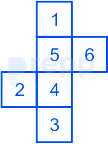
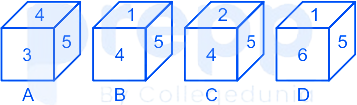
Select the cube that can be formed by folding the given sheet along the lines.
Important Questions from Miscellaneous
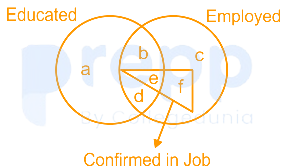
Read the given figure and find the region representing persons who are educated and employed but not confirmed in job.
The magazine in which Mahatma Gandhi mentioned what he wanted the Constitution to do is:
Which gas shields the surface of the earth from ultraviolet radiation from the sun?
Which event is marked as an Intangible Cultural Heritage of Humanity by UNESCO?
Who has been conferred with the rank of the Commander of the Order of the British Empire in 2018?



