
Match the LIST-I with LIST-II Choose the correct answer from the options given below:LIST-I
Boolean Algebra LawLIST-II
AxiomsA. Absorption Law I. a+1=1 B. Bounded Law II. a+0=a C. Identity Law III. a*(b+c)=(a*b)+(a*c) D. Distributive Law IV. a+(a*b)=a
A-IV, B-I, C-II, D-III
Each Boolean algebra law has a standard defining identity (here * is AND and + is OR).
A. Absorption Law — a term absorbs any product that contains it: a+(a*b)=a, because if a=1 both sides are 1 and if a=0 both sides are 0. A → IV.
B. Bounded Law (null / dominance law) — OR with the upper bound 1 always gives 1: a+1=1. B → I.
C. Identity Law — 0 is the identity element of OR, so a+0=a. C → II.
D. Distributive Law — AND distributes over OR: a*(b+c)=(a*b)+(a*c). D → III.
Every other code fails on at least one pair: A-IV, B-III, C-I, D-II calls the distributive identity the bounded law; A-III, B-IV, C-II, D-I makes distributivity the absorption law; A-II, B-III, C-IV, D-I calls a+0=a the absorption law.
A-IV, B-I, C-II, D-III option is correct.
Similar Questions
Which of the following is the complement of the boolean function.
A'B+CD'+A'B+CD'
Consider the Boolean expression given by F=(X+Y+Z)(X'+Y)(Y'+Z).
Which of the following Boolean expressions is/are equivalent to F' (Complement of F)?
A. (X'+Y'+Z')(X+Y')(Y+Z')
B. (XY'+Z')
C. (X+Z')(Y'+Z')
D. (XY'+YZ'+X'Y'Z')
Choose the correct answer from the options given below:
Important Questions from Logic Gates and Boolean Algebra
The digital circuit shown has 3 inputs ($x$, $y$, and $z$).
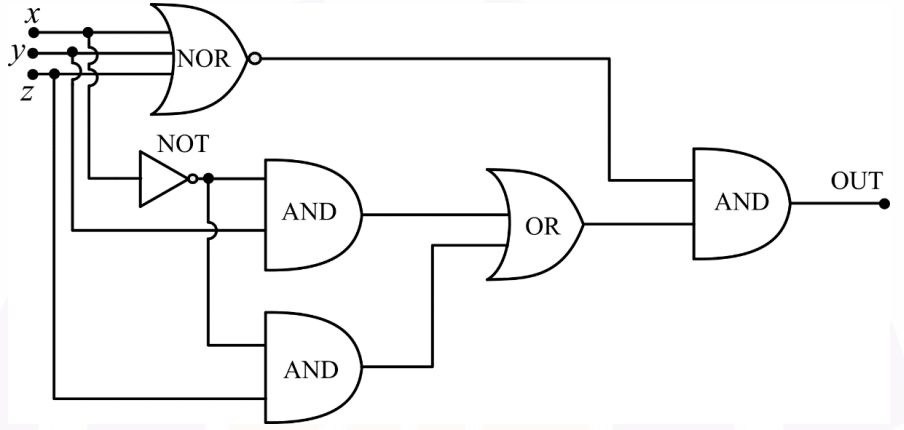
The simplified logical expression for the output (OUT) is:
The MOSFET switches shown in the circuit are ideal.
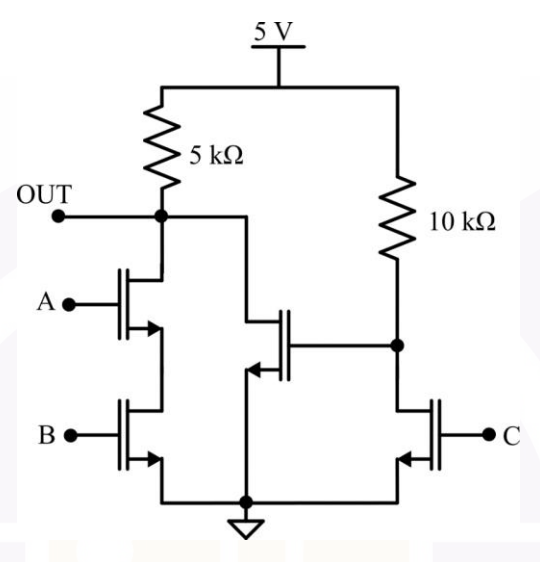
Which of the following is the correct option for Boolean logical expression of the output (OUT), and the maximum possible power (P) consumed by the circuit?
The Boolean expression \(AC+B\bar{C}\) is equivalent to :
Consider the following expressions :
(a) Y = f(A, B, C, D) = Σ (1, 2, 4, 7, 8, 11, 13, 14)
(b) Y = f(A, B, C, D) = Σ (3, 5, 7, 10, 11, 12, 13, 14)
(c) Y = f(A, B, C, D) = Π (0, 3, 5, 6, 9, 10, 12, 15)
(d) Y = f(A, B, C, D) = Π (0, 1, 2, 4, 5, 8, 9, 15)Which of the above expressions are equivalent to the expression Y = A⊕B⊕C⊕D ?
- Match the Exclusive-OR (XOR) operations (i) to (iv) with the results (p) to (s), where X is a Boolean input.
(i) $X \oplus X$ (p) 1 (ii) $X \oplus \bar{X}$ (q) 0 (iii) $X \oplus 0$ (r) $\bar{X}$ (iv) $X \oplus 1$ (s) X



