
(i) $X \oplus X$ (p) 1 (ii) $X \oplus \bar{X}$ (q) 0 (iii) $X \oplus 0$ (r) $\bar{X}$ (iv) $X \oplus 1$ (s) X
Matching XOR Operations to Results
This solution explains the matching of Boolean Exclusive-OR (XOR) operations with their corresponding results. The key property of XOR is that it outputs 1 if the inputs are different, and 0 if they are the same.
Analyzing XOR Operation (i): $X \oplus X$
When a Boolean variable $X$ is XORed with itself, the inputs are always the same. According to the XOR truth table, if inputs are identical, the output is 0.
Therefore, $X \oplus X = 0$. This matches result (q).
Analyzing XOR Operation (ii): $X \oplus \bar{X}$
Here, a Boolean variable $X$ is XORed with its complement $\bar{X}$. These two inputs ($X$ and $\bar{X}$) are always different. If $X=0$, $\bar{X}=1$. If $X=1$, $\bar{X}=0$. Since the inputs are always different, the XOR output is always 1.
Therefore, $X \oplus \bar{X} = 1$. This matches result (p).
Analyzing XOR Operation (iii): $X \oplus 0$
XORing any variable $X$ with the constant 0 results in the variable $X$ itself. This is because XORing with 0 does not change the input's value.
If $X=0$, $0 \oplus 0 = 0$. If $X=1$, $1 \oplus 0 = 1$.
Therefore, $X \oplus 0 = X$. This matches result (s).
Analyzing XOR Operation (iv): $X \oplus 1$
XORing any variable $X$ with the constant 1 results in the inverse (complement) of $X$. This is also known as the NOT operation.
If $X=0$, $0 \oplus 1 = 1$, which is $\bar{X}$. If $X=1$, $1 \oplus 1 = 0$, which is $\bar{X}$.
Therefore, $X \oplus 1 = \bar{X}$. This matches result (r).
Final Matching
Based on the analysis, the correct matches are:
- (i) $X \oplus X$ matches (q) 0
- (ii) $X \oplus \bar{X}$ matches (p) 1
- (iii) $X \oplus 0$ matches (s) X
- (iv) $X \oplus 1$ matches (r) $\bar{X}$
This corresponds to the matching: (i) - (q), (ii) - (p), (iii) - (s), (iv) - (r).
Important Questions from Logic Gates and Boolean Algebra
The digital circuit shown has 3 inputs ($x$, $y$, and $z$).

The simplified logical expression for the output (OUT) is:
The MOSFET switches shown in the circuit are ideal.
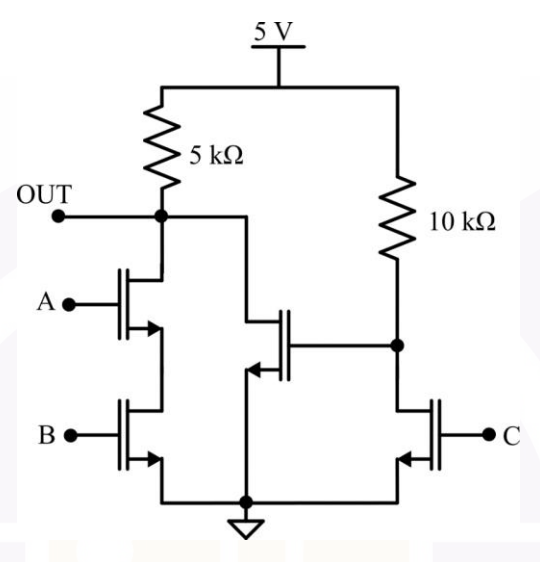
Which of the following is the correct option for Boolean logical expression of the output (OUT), and the maximum possible power (P) consumed by the circuit?
The Boolean expression \(AC+B\bar{C}\) is equivalent to :
Consider the following expressions :
(a) Y = f(A, B, C, D) = Σ (1, 2, 4, 7, 8, 11, 13, 14)
(b) Y = f(A, B, C, D) = Σ (3, 5, 7, 10, 11, 12, 13, 14)
(c) Y = f(A, B, C, D) = Π (0, 3, 5, 6, 9, 10, 12, 15)
(d) Y = f(A, B, C, D) = Π (0, 1, 2, 4, 5, 8, 9, 15)Which of the above expressions are equivalent to the expression Y = A⊕B⊕C⊕D ?
- The expression A + AC + ACD + ACDE + ... is equal to ________.


