
The expression A + AC + ACD + ACDE + ... is equal to ________.
A
Boolean Expression Simplification Explained
The question asks us to simplify the boolean expression: \(\text{A + AC + ACD + ACDE + ...}\). This type of expression often simplifies using fundamental boolean algebra laws, especially the absorption law.
Understanding the Absorption Law
The absorption law is a key principle in boolean algebra that helps simplify expressions. It states that:
- \(\text{A + AB = A}\)
- \(\text{A(A + B) = A}\)
Let's focus on the first part of the law: \(\text{A + AB = A}\). We can prove this by factoring A out:
\[ \text{A + AB = A(1 + B)} \]
In boolean algebra, anything ORed with '1' is '1' (i.e., \(\text{1 + B = 1}\)).
So, the expression becomes:
\[ \text{A(1) = A} \]
This shows that if you have a term 'A' and you OR it with 'A' AND 'B', the 'AB' part gets "absorbed" by 'A', and the result is simply 'A'.
Step-by-Step Simplification of the Expression
Let's apply the absorption law step-by-step to the given expression: \(\text{A + AC + ACD + ACDE + ...}\)
-
Simplifying the first two terms: A + AC
Using the absorption law \(\text{(A + AB = A)}\), where 'A' is 'A' and 'B' is 'C':
\[ \text{A + AC = A} \]
This means our expression now effectively becomes: \(\text{A + ACD + ACDE + ...}\)
-
Simplifying the result with the next term: A + ACD
Now, consider the current simplified expression 'A' and the next term 'ACD'. We can again apply the absorption law. Here, 'A' is 'A', and 'B' can be considered 'CD':
\[ \text{A + ACD = A} \]
Our expression further simplifies to: \(\text{A + ACDE + ...}\)
-
Continuing the pattern: A + ACDE
If we continue this process with the next term 'ACDE', we will find the same result. 'A' is 'A', and 'B' can be considered 'CDE':
\[ \text{A + ACDE = A} \]
Final Result
As we can see from the step-by-step simplification, each subsequent term of the form \(\text{A(something)}\) gets absorbed by the initial 'A' due to the absorption law. This pattern will continue indefinitely for any number of terms added in this form.
Therefore, the entire expression \(\text{A + AC + ACD + ACDE + ...}\) simplifies to simply 'A'.
Important Questions from Logic Gates and Boolean Algebra
The digital circuit shown has 3 inputs ($x$, $y$, and $z$).

The simplified logical expression for the output (OUT) is:
The MOSFET switches shown in the circuit are ideal.
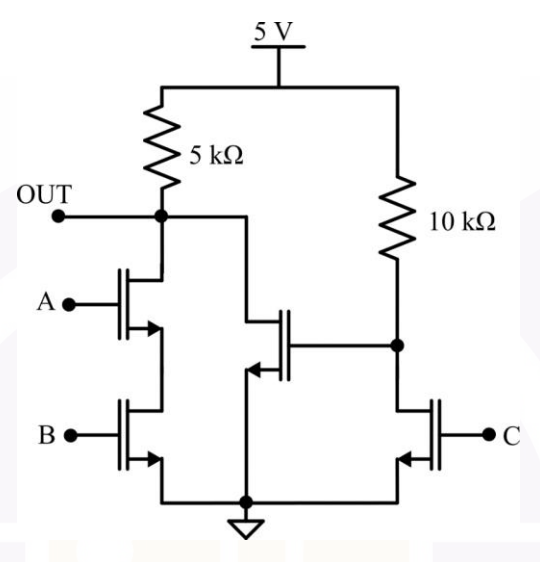
Which of the following is the correct option for Boolean logical expression of the output (OUT), and the maximum possible power (P) consumed by the circuit?
The Boolean expression \(AC+B\bar{C}\) is equivalent to :
Consider the following expressions :
(a) Y = f(A, B, C, D) = Σ (1, 2, 4, 7, 8, 11, 13, 14)
(b) Y = f(A, B, C, D) = Σ (3, 5, 7, 10, 11, 12, 13, 14)
(c) Y = f(A, B, C, D) = Π (0, 3, 5, 6, 9, 10, 12, 15)
(d) Y = f(A, B, C, D) = Π (0, 1, 2, 4, 5, 8, 9, 15)Which of the above expressions are equivalent to the expression Y = A⊕B⊕C⊕D ?
- Match the Exclusive-OR (XOR) operations (i) to (iv) with the results (p) to (s), where X is a Boolean input.
(i) $X \oplus X$ (p) 1 (ii) $X \oplus \bar{X}$ (q) 0 (iii) $X \oplus 0$ (r) $\bar{X}$ (iv) $X \oplus 1$ (s) X


