Match the following
Sandstone Tectonic setup A. Mature quartz arenite D. Continental rift valleys B. Immature wacke E. Passive continental margins C. Feldspathic arenite F. Fore arc basins at convergent plate boundaries
Sandstone Types and Tectonic Settings
Understanding the origin and characteristics of different sandstone types helps match them to specific tectonic environments.
A. Mature quartz arenite: Contains abundant quartz (often >90%), well-sorted and rounded grains. This indicates significant weathering and transport, typically occurring in stable, reworking environments like shallow marine settings on passive margins.
B. Immature wacke: Characterized by a poorly sorted mixture of sand grains, rock fragments, and a significant amount of clay matrix. Angular grains suggest rapid erosion and deposition close to the source, common in tectonically active areas.
C. Feldspathic arenite: Contains a substantial amount of feldspar alongside quartz. This suggests less intense weathering or derivation from an igneous/metamorphic source area rich in feldspar, such as the uplifting blocks in a rift valley.
Matching Sandstone to Tectonic Setup
We match each sandstone type to the tectonic setting most likely to produce its characteristics:
- A. Mature quartz arenite corresponds to E. Passive continental margins. These stable margins allow for extensive reworking and weathering, leading to quartz-rich sediments.
- B. Immature wacke corresponds to F. Fore arc basins at convergent plate boundaries. These basins receive abundant, poorly sorted detritus eroded rapidly from nearby volcanic arcs.
- C. Feldspathic arenite corresponds to D. Continental rift valleys. These settings involve the uplift and erosion of continental crust, often producing feldspar-rich (arkosic) sediments.
Resulting Match
The correct matching based on geological principles is:
A - E, B - F, C - D
Similar Questions
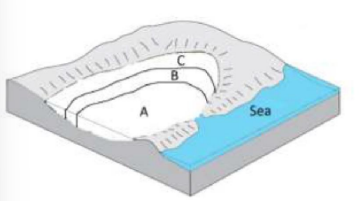
In a semi-isolated barred basin as shown below, which rock types would form because of evaporative mechanism in regions marked by A, B and C?
- A sandstone comprises 70% Quartz, 5% feldspar, 20% matrix and 5% mica. This sandstone is most likely a
Important Questions from Sedimentary Rocks
The modal analysis of a sandstone is as follows:
Quartz 36%
Feldspar 55%
Matrix 08%
Rock fragments 01%
It may be classified as- From the following list of rocks, identify the pair of rocks which are different from others with reference to restricted occurrence in the geological past and mode of origin
- Which of the following sediment types has the highest permeability?
- A blue-coloured calcite spar grain from a stained carbonate rock is analyzed for Mg, Sr and Fe. It is found to be low in Mg and Sr, and high in Fe. It is interpreted as a product of
- Presence of minerals such as pyrite and uraninite as detrital minerals in sedimentary rocks suggests that at the time of deposition