Sediment Permeability Explained
Permeability measures a material's ability to transmit fluids. In sediments, it depends significantly on particle size, shape, sorting, and the interconnectedness of pore spaces.
Analyzing Sediment Types and Permeability
Let's examine how each sediment type affects permeability:
- Mud: Composed of very fine particles (clay and silt). These particles create small, often tortuous pore pathways with poor connectivity, resulting in low permeability.
- Mixture of sand and mud: The fine mud particles can clog the larger pore spaces between sand grains, significantly reducing the overall interconnectedness and thus decreasing permeability compared to clean sand.
- Well sorted sand: Contains sand grains of similar size. This uniformity allows for larger, well-connected pore spaces, facilitating easier fluid flow and leading to high permeability.
- Poorly sorted sand: Includes a wide range of grain sizes. Finer particles fill the spaces between coarser grains, obstructing flow paths and resulting in lower permeability than well-sorted sand.
Conclusion on Permeability
Based on the relationship between sorting and pore space characteristics, well sorted sand offers the most effective pathways for fluid movement, hence exhibiting the highest permeability among the given options.
Important Questions from Sedimentary Rocks
The modal analysis of a sandstone is as follows:
Quartz 36%
Feldspar 55%
Matrix 08%
Rock fragments 01%
It may be classified as- From the following list of rocks, identify the pair of rocks which are different from others with reference to restricted occurrence in the geological past and mode of origin
- A blue-coloured calcite spar grain from a stained carbonate rock is analyzed for Mg, Sr and Fe. It is found to be low in Mg and Sr, and high in Fe. It is interpreted as a product of
- Presence of minerals such as pyrite and uraninite as detrital minerals in sedimentary rocks suggests that at the time of deposition
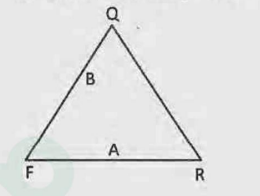
Quartz (Q), feldspar (F) and rock fragment (R) contents are plotted in the given ternary diagram. Identify the correct set of tectonic milieu for ‘A’ and ‘B’ sandstones as plotted in the diagram