Interpreting Detrital Minerals: Pyrite and Uraninite
The presence of specific minerals like pyrite ($FeS_2$) and uraninite ($UO_2$) as detrital grains within sedimentary rocks provides clues about the conditions during their deposition and the environment they originated from.
Mineral Stability and Environmental Conditions
- Pyrite ($FeS_2$): This iron sulfide mineral is unstable in oxidizing environments. In the presence of oxygen ($O_2$) and water ($H_2O$), pyrite readily oxidizes, typically forming iron oxides/hydroxides and sulfuric acid ($H_2SO_4$). Its survival as a detrital mineral suggests it was protected from oxidation.
- Uraninite ($UO_2$): This uranium oxide is primarily stable under reducing (low oxygen) conditions. In oxygen-rich environments, uranium can be oxidized to the soluble uranyl ion ($UO_2^{2+}$), making its preservation as a detrital grain unlikely.
The stability of both pyrite and uraninite as detrital components points towards a depositional environment that lacked sufficient oxygen to cause their breakdown. Such conditions are characteristic of a reducing environment.
Evaluating the Options
- Option 1: Chemical weathering was not active. While oxidative weathering was minimal, other forms of chemical weathering might still have occurred. This option is too broad.
- Option 2: Provenance weathered at a fast rate. Fast weathering, especially involving oxidation, would likely destroy these minerals, making their detrital presence improbable.
- Option 3: Atmosphere had about $1\% \text{ CO}_2$. Carbon dioxide levels influence weathering but do not directly explain the stability of these specific minerals as clearly as oxygen levels do.
- Option 4: Atmosphere had negligible $O_2$. This directly explains the stability of pyrite and uraninite. A low-oxygen atmosphere leads to low-oxygen conditions in surface environments (water bodies, soils), preserving minerals sensitive to oxidation.
Therefore, the presence of detrital pyrite and uraninite strongly suggests that the atmosphere at the time of deposition had very low oxygen levels.
Important Questions from Sedimentary Rocks
The modal analysis of a sandstone is as follows:
Quartz 36%
Feldspar 55%
Matrix 08%
Rock fragments 01%
It may be classified as- From the following list of rocks, identify the pair of rocks which are different from others with reference to restricted occurrence in the geological past and mode of origin
- Which of the following sediment types has the highest permeability?
- A blue-coloured calcite spar grain from a stained carbonate rock is analyzed for Mg, Sr and Fe. It is found to be low in Mg and Sr, and high in Fe. It is interpreted as a product of
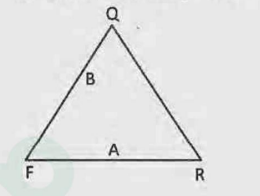
Quartz (Q), feldspar (F) and rock fragment (R) contents are plotted in the given ternary diagram. Identify the correct set of tectonic milieu for ‘A’ and ‘B’ sandstones as plotted in the diagram