Identifying Rocks with Restricted Geological Occurrence and Origin
The question asks to identify a pair of rocks characterized by their limited presence during specific geological past times and unique formation processes.
Banded Iron Formations (BIFs) and Tillites are distinct based on these criteria:
-
Banded Iron Formations (BIFs):
- Mode of Origin: Formed from the chemical precipitation of iron oxides and silica, strongly associated with the rise of oxygen due to early microbial photosynthesis in ancient oceans.
- Geological Occurrence: Predominantly found in rocks of Precambrian age (Archean and Proterozoic Eons).
-
Tillites:
- Mode of Origin: Sedimentary rocks formed from lithified glacial till (ice-deposited debris). They are direct indicators of past major glaciation events.
- Geological Occurrence: Found in strata corresponding to specific periods of widespread glaciation (e.g., Neoproterozoic 'Snowball Earth', Permian Gondwanan glaciation), indicating restricted temporal occurrence.
Comparison with other rocks:
- Limestone: Primarily forms from carbonate sediments (often biogenic) and can occur throughout much of geological history.
- Evaporites: Form from the evaporation of water in restricted basins and, while specific deposits are time-bound, the process is not as uniquely restricted in time or origin as BIFs or Tillites.
Therefore, Banded Iron Formation and Tillite represent a pair with highly specific origins and restricted occurrences in the geological past compared to Limestone and Evaporites.
Important Questions from Sedimentary Rocks
The modal analysis of a sandstone is as follows:
Quartz 36%
Feldspar 55%
Matrix 08%
Rock fragments 01%
It may be classified as- Which of the following sediment types has the highest permeability?
- A blue-coloured calcite spar grain from a stained carbonate rock is analyzed for Mg, Sr and Fe. It is found to be low in Mg and Sr, and high in Fe. It is interpreted as a product of
- Presence of minerals such as pyrite and uraninite as detrital minerals in sedimentary rocks suggests that at the time of deposition
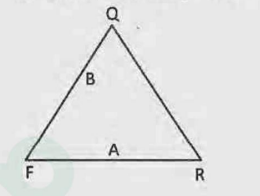
Quartz (Q), feldspar (F) and rock fragment (R) contents are plotted in the given ternary diagram. Identify the correct set of tectonic milieu for ‘A’ and ‘B’ sandstones as plotted in the diagram