The classification of sandstone depends primarily on the percentage of matrix (finer material like clay and silt) and the relative abundance of framework grains (quartz, feldspar, lithic fragments).
Sandstone Composition Analysis
The given sandstone composition is:
| Component | Percentage |
|---|---|
| Quartz | $70\%$ |
| Feldspar | $5\%$ |
| Matrix | $20\%$ |
| Mica | $5\%$ |
Classification Criteria: Arenite vs. Wacke
Sandstones are broadly classified based on matrix content:
- Arenites: Contain less than $15\%$ matrix.
- Wackes: Contain $15\%$ or more matrix.
This sandstone contains $20\%$ matrix, which is greater than $15\%$. Therefore, it belongs to the Wacke category.
Specific Type: Quartzwacke Determination
Wackes are further classified based on their dominant framework grain:
- Quartz wacke: The framework grains are predominantly quartz.
- Feldspathic wacke: The framework grains are predominantly feldspar.
- Lithic wacke: The framework grains are predominantly rock fragments.
In this case, the framework grains are Quartz ($70\%$), Feldspar ($5\%$), and Mica ($5\%$). Quartz is the dominant framework grain ($70\%$).
Since the sandstone has more than $15\%$ matrix and the dominant framework grain is quartz, it is classified as a Quartz wacke, commonly referred to as Quartzwacke.
Conclusion
Based on the high matrix content ($20\%$) and dominant quartz framework ($70\%$), the sandstone is most likely a Quartzwacke.
Similar Questions
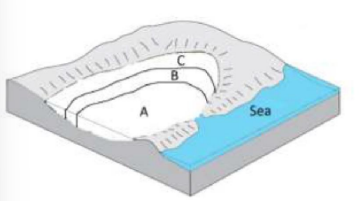
In a semi-isolated barred basin as shown below, which rock types would form because of evaporative mechanism in regions marked by A, B and C?
Match the following
Sandstone Tectonic setup A. Mature quartz arenite D. Continental rift valleys B. Immature wacke E. Passive continental margins C. Feldspathic arenite F. Fore arc basins at convergent plate boundaries
Important Questions from Sedimentary Rocks
The modal analysis of a sandstone is as follows:
Quartz 36%
Feldspar 55%
Matrix 08%
Rock fragments 01%
It may be classified as- From the following list of rocks, identify the pair of rocks which are different from others with reference to restricted occurrence in the geological past and mode of origin
- Which of the following sediment types has the highest permeability?
- A blue-coloured calcite spar grain from a stained carbonate rock is analyzed for Mg, Sr and Fe. It is found to be low in Mg and Sr, and high in Fe. It is interpreted as a product of
- Presence of minerals such as pyrite and uraninite as detrital minerals in sedimentary rocks suggests that at the time of deposition