
Match the following lists : Choose the correct answer from the codes given below:List - I List - II a) 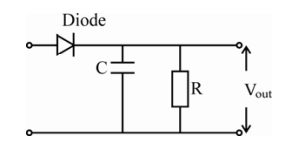
i) Frequency modulated detector b) 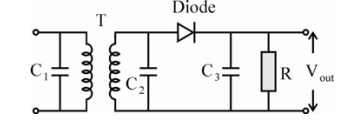
ii) Pre-emphasis c) 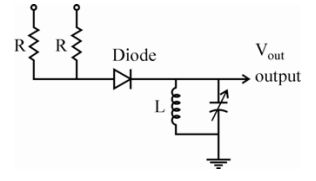
iii) Amplitude modulator d) 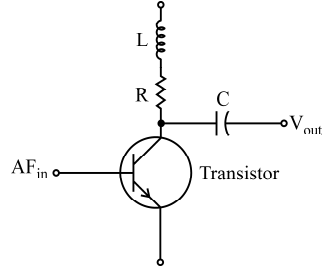
iv) Amplitude detector
a-iv, b-i, c-iii, d-ii
Each circuit is identified by the one element that gives its function away.
a → iv. Amplitude detector. A series diode followed by a parallel R–C is the classic envelope detector. The diode rectifies the modulated carrier and the capacitor holds the peak between cycles, so the output follows the envelope — i.e. the message. The time constant must satisfy
\(\dfrac{1}{f_c}\ll RC\ll\dfrac{1}{f_m}\)
fast enough to follow the modulation but slow enough to smooth the carrier; too large an RC produces diagonal clipping.
b → i. Frequency modulated detector. The giveaway is the tuned transformer feeding the diode. An FM detector must first convert frequency variations into amplitude variations, and a tuned circuit operated on the slope of its response does exactly that; the diode and RC then recover the resulting envelope. This slope/ratio-detector arrangement is the standard FM demodulator.
c → iii. Amplitude modulator. Here the diode is driven from a resistive divider and its output feeds an L–C tuned tank. The non-linear diode mixes the carrier and modulating signals, generating sum and difference frequencies, and the tank selects the wanted band around the carrier — producing AM rather than detecting it. Non-linearity plus a tuned output is always a modulator.
d → ii. Pre-emphasis. The audio enters a transistor whose collector load is an inductor in series with a resistor. Since \(X_L=\omega L\) rises with frequency, so does the stage gain: the circuit deliberately boosts the treble before modulation. At the receiver a matching de-emphasis network restores the balance and, in doing so, attenuates the high-frequency noise that FM detection produces — improving the output signal-to-noise ratio. The standard time constant is 75 μs.
Recognition rule: diode + RC → detector; tuned transformer ahead of the diode → FM detector; non-linear device with a tuned output → modulator; a series L in the load → a deliberate high-frequency boost, i.e. pre-emphasis.
Hence, the correct matching is a-iv, b-i, c-iii, d-ii.
Similar Questions
Match the following lists :
List – I List – II a. PCM i. Slope overload distortion b. DM ii. Constant carrier frequency c. AM iii. Encoding d. TDM iv. Commutator The correct match is :
Match the following :
List – I List – II a. DSB-SC modulation i. envelope detection b. SSB-modulation ii. Foster Seeley c. AM-demodulation iii. Weaver's method d. Phase-shift detection iv. Balanced modulator Codes :
Match the following :
List – I List – II a. Power efficient transmission i. SSB-SC b. Most bandwidth efficient transmission of voice signal ii. VSB c. Simplest receiver iii. FM d. Bandwidth efficient transmission of signals with significant d.c. component iv. AM Codes :
Match List - I with List - II.
List - I List - II (A) White noise (I) Reduces antenna height (B) RMS noise voltage (II) \(P_{C}\left(\dfrac{m^{2}}{2}\right)\) (C) Modulation (III) Inversely proportional to \(\sqrt{T}\) (D) PDSBSC (IV) Johnson Noise Choose the correct answer from the options given below :
Match the following lists :
List -I List - II a. Power efficient transmission of signals i. AM b. Bandwidth efficient transmission of signals with significant dc signals ii. VSB c. Most bandwidth efficient transmission of voice signals iii. SSB-SC d. Simplest Receiver Circuit iv. FM Correct Codes are :
Arrange in order of the increasing Bandwidth value for the below mentioned systems :
(a) DSB-SC (b) VSB (c) FM (d) SSB
Codes :
Important Questions from Modulation
Which of the following modulations is used in India for radio transmission?
- Which of the following is a result of over-modulation?
Which of the following statements are correct?
A. DSB‐SC modulation is well suited for point to point communication involving one transmitter and one receiver.
B. VSB modulation is a linear modulation scheme.
C. SSB is a non‐linear modulation scheme.
D. FM is a linear modulation scheme.
Choose the correct answer from the options given below:
The condition for achieving distortion-less demodulation of an amplitude-modulated signal using an envelope detector is
When a broadcast AM transmitter is 50 % modulated, its antenna current is 12 A. What will be the current when the modulation depth is increased to 90%?



