In an N-channel MOSFET, the drain current ID increases as _______.
the gate-to-source voltage increases above the threshold voltage
In an N-channel MOSFET, the drain current, ID, is primarily controlled by the gate-to-source voltage, VGS. When the gate-to-source voltage exceeds a certain threshold, known as the threshold voltage, Vth, the MOSFET enters its conducting state, allowing current to flow from the drain to the source. As VGS increases beyond this threshold, the channel between the source and drain becomes more conductive, enhancing the drain current ID. Therefore, the correct answer is that the drain current increases as the gate-to-source voltage increases above the threshold voltage.
Important Questions from MOSFET
The O in a MOSFET stands for _______ layer which provides _______ to the device.
Which industry does aluminium smelting belong to?
Consider an ideal long channel nMOSFET (enhancement-mode) with gate length 10 µm and width 100 µm. The product of electron mobility (µn) and oxide capacitance per unit area (COX) is µn COX = 1 mA/V2 . The threshold voltage of the transistor is 1 V. For a gate-to-source voltage VGS = [2 − sin (2t)] V and drain-to-source voltage VDS = 1 V (substrate connected to the source), the maximum value of the drain-to-source current is ________.
- A power MOSFET is a ___________, __________ controlled and ___________ carrier device.
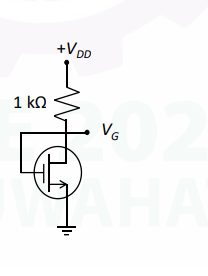
An n-channel MOSFET is connected as shown in the Figure.
Assume $V_{TH} = 1\text{ V}$, $V_{DD} = 5\text{ V}$, and $\mu C_{ox}\left(\frac{W}{L}\right) = 2\text{ mA V}^{-2}$ and neglect channel length modulation effects.
The gate voltage ($V_G$) of the n-channel MOSFET (in Volt) is __.
(rounded off to two decimal places)