Consider an ideal long channel nMOSFET (enhancement-mode) with gate length 10 µm and width 100 µm. The product of electron mobility (µn) and oxide capacitance per unit area (COX) is µn COX = 1 mA/V2 . The threshold voltage of the transistor is 1 V. For a gate-to-source voltage VGS = [2 − sin (2t)] V and drain-to-source voltage VDS = 1 V (substrate connected to the source), the maximum value of the drain-to-source current is ________.
15 mA
nMOSFET Problem Overview
This problem involves analyzing the behavior of an ideal long channel nMOSFET (enhancement-mode) to determine its maximum drain-to-source current. We are provided with the transistor's physical dimensions, material properties, threshold voltage, and time-varying gate-to-source voltage, along with a constant drain-to-source voltage.
Given Parameters and Values
Let's list the key parameters provided in the question:
- Transistor type: Ideal long channel nMOSFET (enhancement-mode)
- Gate length ($L$): $10 \, \mu\text{m}$
- Width ($W$): $100 \, \mu\text{m}$
- Product of electron mobility ($\mu_n$) and oxide capacitance per unit area ($C_{OX}$): $\mu_n C_{OX} = 1 \, \text{mA/V}^2$
- Threshold voltage ($V_T$): $1 \, \text{V}$
- Gate-to-source voltage ($V_{GS}$): $[2 - \sin(2t)] \, \text{V}$
- Drain-to-source voltage ($V_{DS}$): $1 \, \text{V}$
- Substrate is connected to the source.
Transistor Operation Analysis
MOSFET Transconductance Parameter
First, we calculate the transconductance parameter, often denoted as $K$ or $\beta$, which is crucial for current calculations in an nMOSFET. It is given by:
$$K = \mu_n C_{OX} \frac{W}{L}$$
Substitute the given values:
$$K = (1 \, \text{mA/V}^2) \left( \frac{100 \, \mu\text{m}}{10 \, \mu\text{m}} \right)$$
$$K = (1 \, \text{mA/V}^2) \times 10$$
$$K = 10 \, \text{mA/V}^2$$
Gate-to-Source Voltage Range
The gate-to-source voltage ($V_{GS}$) is a time-varying signal given by $V_{GS} = [2 - \sin(2t)] \, \text{V}$. To find the maximum drain-to-source current, we need to consider the range of $V_{GS}$.
The sine function, $\sin(2t)$, oscillates between $-1$ and $1$.
- Maximum $V_{GS}$ value: This occurs when $\sin(2t)$ is at its minimum, which is $-1$. $$V_{GS,max} = 2 - (-1) = 3 \, \text{V}$$
- Minimum $V_{GS}$ value: This occurs when $\sin(2t)$ is at its maximum, which is $1$. $$V_{GS,min} = 2 - 1 = 1 \, \text{V}$$
So, the gate-to-source voltage ranges from $1 \, \text{V}$ to $3 \, \text{V}$. We are looking for the maximum drain-to-source current ($I_{DS}$). Generally, for an enhancement-mode nMOSFET, $I_{DS}$ increases with $V_{GS}$ when the transistor is ON. Therefore, the maximum $I_{DS}$ will occur at the maximum $V_{GS}$, which is $3 \, \text{V}$.
Determining Operating Region
An enhancement-mode nMOSFET operates in different regions based on the terminal voltages. For it to conduct current, $V_{GS}$ must be greater than $V_T$. In our case, $V_{GS,min} = 1 \, \text{V}$ which is equal to $V_T = 1 \, \text{V}$. This means the transistor can be in cut-off (no current), triode (linear), or saturation regions.
We are interested in the condition for maximum $I_{DS}$, which occurs at $V_{GS} = V_{GS,max} = 3 \, \text{V}$. Let's determine the operating region for $V_{GS} = 3 \, \text{V}$ and $V_{DS} = 1 \, \text{V}$.
First, calculate the overdrive voltage ($V_{OV}$), which is $V_{GS} - V_T$:
$$V_{OV} = V_{GS} - V_T = 3 \, \text{V} - 1 \, \text{V} = 2 \, \text{V}$$
Now, compare $V_{DS}$ with $V_{GS} - V_T$ to identify the operating region:
- If $V_{DS} < V_{GS} - V_T$, the MOSFET is in the Triode (Linear) Region.
- If $V_{DS} \ge V_{GS} - V_T$, the MOSFET is in the Saturation Region.
Given $V_{DS} = 1 \, \text{V}$ and $V_{GS} - V_T = 2 \, \text{V}$.
Since $1 \, \text{V} < 2 \, \text{V}$ ($V_{DS} < V_{GS} - V_T$), the nMOSFET is operating in the Triode (Linear) Region at the point where $I_{DS}$ is maximum.
Drain Current Calculation
Maximum Drain-to-Source Current
For an ideal long channel nMOSFET operating in the Triode (Linear) Region, the drain-to-source current ($I_{DS}$) is given by the formula:
$$I_{DS} = K \left[ (V_{GS} - V_T)V_{DS} - \frac{1}{2}V_{DS}^2 \right]$$
Now, substitute the values for maximum $I_{DS}$ (i.e., with $V_{GS} = 3 \, \text{V}$):
- $K = 10 \, \text{mA/V}^2$
- $V_{GS} = 3 \, \text{V}$
- $V_T = 1 \, \text{V}$
- $V_{DS} = 1 \, \text{V}$
$$I_{DS,max} = (10 \, \text{mA/V}^2) \left[ (3 \, \text{V} - 1 \, \text{V})(1 \, \text{V}) - \frac{1}{2}(1 \, \text{V})^2 \right]$$
$$I_{DS,max} = (10 \, \text{mA/V}^2) \left[ (2 \, \text{V})(1 \, \text{V}) - \frac{1}{2}(1 \, \text{V}^2) \right]$$
$$I_{DS,max} = (10 \, \text{mA/V}^2) \left[ 2 \, \text{V}^2 - 0.5 \, \text{V}^2 \right]$$
$$I_{DS,max} = (10 \, \text{mA/V}^2) \left[ 1.5 \, \text{V}^2 \right]$$
$$I_{DS,max} = 15 \, \text{mA}$$
Final Answer
The maximum value of the drain-to-source current is $15 \, \text{mA}$.
Important Questions from MOSFET
The O in a MOSFET stands for _______ layer which provides _______ to the device.
Which industry does aluminium smelting belong to?
In an N-channel MOSFET, the drain current ID increases as _______.
- A power MOSFET is a ___________, __________ controlled and ___________ carrier device.
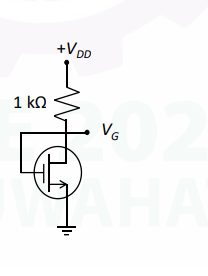
An n-channel MOSFET is connected as shown in the Figure.
Assume $V_{TH} = 1\text{ V}$, $V_{DD} = 5\text{ V}$, and $\mu C_{ox}\left(\frac{W}{L}\right) = 2\text{ mA V}^{-2}$ and neglect channel length modulation effects.
The gate voltage ($V_G$) of the n-channel MOSFET (in Volt) is __.
(rounded off to two decimal places)