Which industry does aluminium smelting belong to?
Understanding Aluminium Smelting and Industry Classification
The question asks us to identify the industry to which aluminium smelting belongs. Aluminium smelting is a crucial process in the production of aluminium metal from its raw material.
What is Aluminium Smelting?
Aluminium smelting is the process of extracting pure aluminium from aluminium oxide (alumina), which is typically obtained from bauxite ore. This process is usually done using electrolysis in a high-temperature environment. The main steps involve:
- Mining of bauxite ore.
- Refining bauxite to produce alumina ($\text{Al}_2\text{O}_3$).
- Electrolytic reduction of alumina in molten cryolite, typically using the Hall-Héroult process, to produce molten aluminium.
- Casting the molten aluminium into various shapes like ingots or billets.
This process fundamentally deals with the extraction, purification, and production of a metal from its ore.
Exploring the Industry Options
Let's look at the provided industry options to see which one fits aluminium smelting:
- Textile Industry: This industry deals with the production of yarn, fabric, and clothing from fibres (natural or synthetic). Aluminium smelting is not related to this.
- Chemical Industry: This industry involves the production of chemicals, often through chemical reactions and processes. While chemical processes are involved in producing alumina and the electrolysis process has chemical aspects, the primary output is a metal, not a chemical product in the typical sense (like acids, alkalis, plastics, etc.).
- Sugar Industry: This industry processes sugarcane or sugar beets to produce sugar. This is unrelated to metal production.
- Metallurgical Industry: This industry is concerned with the extraction, refining, alloying, fabrication, and treatment of metals. It covers the entire process from ore to finished metal products.
Why Aluminium Smelting is Metallurgical
Since aluminium smelting is the process of extracting and producing aluminium metal from its ore, it directly falls under the definition and scope of the metallurgical industry. Metallurgy is the science and technology of metals, and smelting is a core metallurgical technique used for extracting metals.
Therefore, aluminium smelting is a key activity within the metallurgical industry.
| Industry | Primary Focus | Relevance to Aluminium Smelting |
|---|---|---|
| Textile | Fabrics, Clothing | None |
| Chemical | Chemicals, Compounds | Involves chemical processes, but primary output is metal |
| Sugar | Sugar Production | None |
| Metallurgical | Metal Extraction, Processing, Production | Directly relevant; smelting is a core activity |
Based on the nature of the process and the output, aluminium smelting is classified under the metallurgical industry.
Revision Table: Aluminium Smelting
| Aspect | Description |
|---|---|
| Process | Extraction of aluminium from alumina ($\text{Al}_2\text{O}_3$) |
| Primary Method | Electrolysis (e.g., Hall-Héroult process) |
| Raw Material | Alumina (from bauxite) |
| Output | Pure Aluminium Metal |
| Industry | Metallurgical Industry |
Additional Information on Metallurgy
The metallurgical industry is broadly divided into ferrous metallurgy (dealing with iron and steel) and non-ferrous metallurgy (dealing with other metals like aluminium, copper, lead, zinc, etc.). Aluminium smelting is part of non-ferrous metallurgy. This industry is vital for producing the materials used in construction, automotive, aerospace, electronics, and many other sectors.
Important Questions from MOSFET
The O in a MOSFET stands for _______ layer which provides _______ to the device.
In an N-channel MOSFET, the drain current ID increases as _______.
Consider an ideal long channel nMOSFET (enhancement-mode) with gate length 10 µm and width 100 µm. The product of electron mobility (µn) and oxide capacitance per unit area (COX) is µn COX = 1 mA/V2 . The threshold voltage of the transistor is 1 V. For a gate-to-source voltage VGS = [2 − sin (2t)] V and drain-to-source voltage VDS = 1 V (substrate connected to the source), the maximum value of the drain-to-source current is ________.
- A power MOSFET is a ___________, __________ controlled and ___________ carrier device.
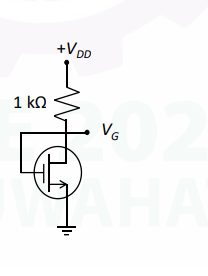
An n-channel MOSFET is connected as shown in the Figure.
Assume $V_{TH} = 1\text{ V}$, $V_{DD} = 5\text{ V}$, and $\mu C_{ox}\left(\frac{W}{L}\right) = 2\text{ mA V}^{-2}$ and neglect channel length modulation effects.
The gate voltage ($V_G$) of the n-channel MOSFET (in Volt) is __.
(rounded off to two decimal places)