
An n-channel MOSFET is connected as shown in the Figure.
Assume $V_{TH} = 1\text{ V}$, $V_{DD} = 5\text{ V}$, and $\mu C_{ox}\left(\frac{W}{L}\right) = 2\text{ mA V}^{-2}$ and neglect channel length modulation effects.
The gate voltage ($V_G$) of the n-channel MOSFET (in Volt) is __.
(rounded off to two decimal places)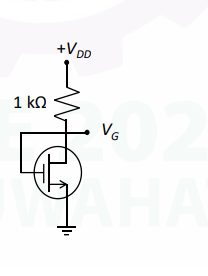
To find the gate voltage \( V_G \) of the n-channel MOSFET, we start by analyzing the circuit. The MOSFET is in saturation since it's connected as a source follower with \( V_{DD} > V_{TH} \). The current equation in saturation is:
\[ I_D = \frac{1}{2}\mu C_{ox}\left(\frac{W}{L}\right)(V_{GS} - V_{TH})^2 \]
Here, the drain current (\( I_D \)) through the 1 kΩ resistor can be calculated as:
\[ I_D = \frac{V_{DD} - V_G}{1 \, \text{k}\Omega} \]
Equating both expressions for \( I_D \):
\[\frac{V_{DD} - V_G}{1 \, \text{k}\Omega} = \frac{1}{2} \cdot 2 \, \text{mA/V}^2 \cdot (V_G - V_{TH})^2\]
\[V_{DD} - V_G = (V_G - V_{TH})^2\]
Substitute \( V_{DD} = 5 \, \text{V} \) and \( V_{TH} = 1 \, \text{V} \):
\[5 - V_G = (V_G - 1)^2\]
Expanding and simplifying:
\[5 - V_G = V_G^2 - 2V_G + 1\]
\[V_G^2 - V_G - 4 = 0\]
Using the quadratic formula \( V_G = \frac{-b \pm \sqrt{b^2 - 4ac}}{2a} \), where \( a = 1 \), \( b = -1 \), \( c = -4 \):
\[V_G = \frac{1 \pm \sqrt{1 + 16}}{2}\]
\[V_G = \frac{1 \pm \sqrt{17}}{2}\]
Since \( \sqrt{17} \approx 4.12 \):
\[V_G = \frac{1 \pm 4.12}{2}\]
Calculating the positive root (ensures \( V_{GS} > V_{TH} \)):
\[V_G = \frac{5.12}{2} = 2.56 \, \text{V}\]
Thus, the computed \( V_G \) of 2.56 V falls within the expected range of 2.5 to 2.6 V.
Important Questions from MOSFET
The O in a MOSFET stands for _______ layer which provides _______ to the device.
Which industry does aluminium smelting belong to?
In an N-channel MOSFET, the drain current ID increases as _______.
Consider an ideal long channel nMOSFET (enhancement-mode) with gate length 10 µm and width 100 µm. The product of electron mobility (µn) and oxide capacitance per unit area (COX) is µn COX = 1 mA/V2 . The threshold voltage of the transistor is 1 V. For a gate-to-source voltage VGS = [2 − sin (2t)] V and drain-to-source voltage VDS = 1 V (substrate connected to the source), the maximum value of the drain-to-source current is ________.
- A power MOSFET is a ___________, __________ controlled and ___________ carrier device.


