A power MOSFET is a ___________, __________ controlled and ___________ carrier device.
A power MOSFET (Metal-Oxide-Semiconductor Field-Effect Transistor) is a crucial semiconductor device extensively used in power electronics for high-speed switching applications. The question asks us to identify three fundamental characteristics of a power MOSFET: its carrier type, its control mechanism, and the type of charge carriers responsible for its operation.
Power MOSFET Characteristics Explained
Let's analyze each characteristic to understand why the power MOSFET falls into specific categories:
Unipolar Device Operation
- A unipolar device is an electronic component where the electrical current is carried predominantly by only one type of charge carrier (either electrons or holes).
- In contrast, a bipolar device, such as a Bipolar Junction Transistor (BJT), relies on the flow of both electrons and holes, involving the injection and recombination of minority carriers.
- A power MOSFET operates as a unipolar device because the current conduction through its channel is solely due to the movement of **majority carriers**. For an N-channel MOSFET, this means electrons, and for a P-channel MOSFET, this means holes.
Voltage Controlled Nature
- A voltage-controlled device is one where the output current is regulated by an input voltage. For a MOSFET, the drain current is controlled by the gate-source voltage ($V_{GS}$).
- In contrast, a current-controlled device (like a BJT) has its output current determined by an input current (base current).
- The gate terminal of a power MOSFET is electrically isolated from the channel by a thin insulating layer of silicon dioxide. An electric field, created by the gate voltage, induces and modulates the conductive channel between the source and drain terminals. Therefore, the power MOSFET is intrinsically a voltage-controlled device, requiring minimal gate current to operate.
Majority Carrier Conduction
- A majority carrier device is one where the primary mechanism of current flow is through the movement of the most abundant charge carriers in the semiconductor region where conduction occurs.
- A minority carrier device, on the other hand, depends significantly on the generation, injection, and recombination of minority carriers for its operation (e.g., in the base region of a BJT).
- In a power MOSFET, once the conductive channel is formed by the applied gate voltage, the current from source to drain flows entirely by the drift of majority carriers within this channel. There is no significant involvement of minority carrier injection or recombination in the primary current path. This characteristic makes the power MOSFET a true majority carrier device.
Based on these fundamental principles, the characteristics of a power MOSFET can be summarized as follows:
| Characteristic | Description for Power MOSFET |
|---|---|
| Carrier Type | Unipolar (conduction by one type of carrier only) |
| Control Mechanism | Voltage-controlled (gate-source voltage controls the current) |
| Primary Charge Carriers | Majority carriers (electrons in N-channel, holes in P-channel) |
Therefore, a power MOSFET is correctly described as a unipolar, voltage-controlled, and majority carrier device.
Important Questions from MOSFET
The O in a MOSFET stands for _______ layer which provides _______ to the device.
Which industry does aluminium smelting belong to?
In an N-channel MOSFET, the drain current ID increases as _______.
Consider an ideal long channel nMOSFET (enhancement-mode) with gate length 10 µm and width 100 µm. The product of electron mobility (µn) and oxide capacitance per unit area (COX) is µn COX = 1 mA/V2 . The threshold voltage of the transistor is 1 V. For a gate-to-source voltage VGS = [2 − sin (2t)] V and drain-to-source voltage VDS = 1 V (substrate connected to the source), the maximum value of the drain-to-source current is ________.
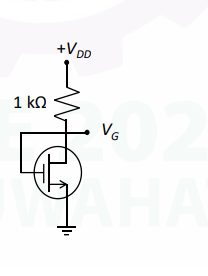
An n-channel MOSFET is connected as shown in the Figure.
Assume $V_{TH} = 1\text{ V}$, $V_{DD} = 5\text{ V}$, and $\mu C_{ox}\left(\frac{W}{L}\right) = 2\text{ mA V}^{-2}$ and neglect channel length modulation effects.
The gate voltage ($V_G$) of the n-channel MOSFET (in Volt) is __.
(rounded off to two decimal places)