
In a circle with centre O, an arc ABC subtends an angle of 140° at the centre of the circle. The chord AB is produced to point P. Then ∠CBP is equal to:
70°
Understanding the Circle Geometry Problem
The question asks us to find the measure of the angle ∠CBP, where A, B, and C are points on a circle with center O, an arc ABC subtends an angle of 140° at the center, and the chord AB is extended to a point P.
Let's break down the given information:
- We have a circle with center O.
- A, B, C are points on the circle, likely in that order along the arc.
- The arc ABC subtends an angle of 140° at the center O. This means the angle formed by the radii OA and OC is 140°, so ∠AOC = 140°.
- The chord AB is extended to a point P, forming a straight line segment ABP.
- We need to find the measure of the exterior angle ∠CBP.
Applying Circle Theorems to Find Angles
To find ∠CBP, we first need to find ∠ABC, as they form a linear pair (∠ABC + ∠CBP = 180°). ∠ABC is an angle subtended by the arc AC at the circumference.
The arc AC subtends ∠AOC = 140° at the center. According to the circle theorem, the angle subtended by an arc at the center is double the angle subtended by the same arc at any point on the remaining part of the circle.
Let D be any point on the major arc AC. The minor arc AC subtends ∠AOC = 140° at the center. It subtends ∠ADC at the circumference.
Using the theorem: $$ \angle\text{ADC} = \frac{1}{2} \times \angle\text{AOC} $$ $$ \angle\text{ADC} = \frac{1}{2} \times 140^\circ $$ $$ \angle\text{ADC} = 70^\circ $$
Now, consider the quadrilateral ABCD. Since all four points A, B, C, and D lie on the circle, ABCD is a cyclic quadrilateral.
In a cyclic quadrilateral, the sum of opposite angles is 180° (they are supplementary).
So, we have: $$ \angle\text{ABC} + \angle\text{ADC} = 180^\circ $$
Substitute the value of ∠ADC we found: $$ \angle\text{ABC} + 70^\circ = 180^\circ $$ $$ \angle\text{ABC} = 180^\circ - 70^\circ $$ $$ \angle\text{ABC} = 110^\circ $$
Calculating the Exterior Angle ∠CBP
The points A, B, and P lie on a straight line because chord AB is produced to P. Therefore, the angles ∠ABC and ∠CBP form a linear pair.
The sum of angles in a linear pair is always 180°.
So, we have: $$ \angle\text{ABC} + \angle\text{CBP} = 180^\circ $$
Substitute the value of ∠ABC we calculated: $$ 110^\circ + \angle\text{CBP} = 180^\circ $$ $$ \angle\text{CBP} = 180^\circ - 110^\circ $$ $$ \angle\text{CBP} = 70^\circ $$
Thus, the angle ∠CBP is equal to 70°.
| Step | Calculation/Reasoning | Result |
|---|---|---|
| 1 | Central angle subtended by arc AC | ∠AOC = 140° |
| 2 | Angle at circumference by minor arc AC (e.g., ∠ADC) | ∠ADC = 140° / 2 = 70° |
| 3 | ∠ABC and ∠ADC are opposite angles in cyclic quadrilateral ABCD | ∠ABC + ∠ADC = 180° |
| 4 | Calculate ∠ABC | ∠ABC = 180° - 70° = 110° |
| 5 | ∠ABC and ∠CBP form a linear pair | ∠ABC + ∠CBP = 180° |
| 6 | Calculate ∠CBP | ∠CBP = 180° - 110° = 70° |
Revision Table: Key Concepts for Circle Geometry
| Concept | Description | Relevant Theorem |
|---|---|---|
| Central Angle | Angle formed by two radii at the center of the circle. | Angle at center is twice the angle at circumference. |
| Inscribed Angle | Angle formed by two chords meeting on the circumference. | Half the central angle subtending the same arc. |
| Cyclic Quadrilateral | A quadrilateral whose all four vertices lie on the circumference of a circle. | Opposite angles sum to 180°. Exterior angle equals interior opposite angle. |
| Linear Pair | Two adjacent angles that form a straight line. | Their sum is 180°. |
Additional Information: Cyclic Quadrilateral Properties
A cyclic quadrilateral has several important properties related to its angles:
- The sum of each pair of opposite angles is 180 degrees. For cyclic quadrilateral ABCD, ∠A + ∠C = 180° and ∠B + ∠D = 180°.
- If a side of a cyclic quadrilateral is produced, the exterior angle formed is equal to the interior opposite angle. In our problem, ∠CBP is the exterior angle formed by extending AB. ∠CBP is equal to the interior opposite angle ∠ADC. We calculated ∠ADC = 70°, which matches our result for ∠CBP. This serves as an alternative way to find the answer after finding ∠ADC.
- The converse is also true: if the opposite angles of a quadrilateral are supplementary, then the quadrilateral is cyclic.
These properties are fundamental when solving problems involving cyclic quadrilaterals and angles in circles.
Similar Questions
O is the centre of this circle. Tangent drawn from a point P, touches the circle at Q. If PQ = 24 cm and OQ = 10 cm, then what is the value of OP?
AC is the diameter of a circle dividing the circle into two semicircles. ED is a chord in one semicircle, such that ED is parallel to AC. B is a point on the circumference of the circle in the other semicircle. ∠CBE = 75°. What is the measure (in degrees) of ∠CED?
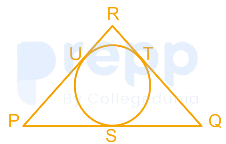
In the given figure, a circle inscribed in ∆PQR touches its sides PQ, QR and RP at points S, T and U, respectively. If PQ = 15 cm, QR = 10 cm, and RP = 12 cm, then find the lengths of PS, QT and RU?
In a circle, AB is the diameter and CD is a chord. AB and CD produced meet at a point P, outside the circle. If PD = 15.3 cm, CD = 11.9 cm and AP = 30.6 cm, then the radius of the circle is:
Point P lies outside a circle with centre O. Tangents PA and PB are drawn to meet the circle at A and B respectively. If ∠APB = 80°, then ∠OAB is equal to:
ΔABC is incribed in a circle with center O, such that ∠ACB = 115°, O is joined to A. What is the measure of ∠OAB?
In the given figure, if AB = 10 cm, CD = 7 cm, SD = 4 cm and AS = 5 cm, then BC = ?
PQ and RS are common tangents to two circles intersecting at A and B. AB, when produced both sides, meet the tangents PQ and RS at X and Y, respectively. If AB = 3 cm, XY = 5 cm, then PQ (in cm) will be
In a circle, a diameter AB and a chord PQ (which is not a diameter) intersect each other at X perpendicularly. If AX : BX = 3 : 2 and the radius of the circle is 5 cm, then the length of chord PQ is
The vertices of ΔPQR lie on a circle with centre O, SR is a tangent to the circle at the point R. If QR bisects the ∠ORS, then what is the measures of ∠RPQ?
Important Questions from Circles, Chords and Tangents
- A circular coin of radius 1 cm is allowed to roll freely on the periphery over a circular disc of radius 10 cm. If the disc has no movement and the coin completes one revolution rolling on the periphery over the disc and without slipping, then what is the number of times the coin rotated about its centre ?
There are two concentric circles. The radii of the two circles are 100 m and 110 m respectively. A wheel of radius 30 cm rolls on the smaller circle and another wheel rolls on the larger circle. After they have completed one revolution, it is found that the two wheels rolled equal number of times
on their respective axes. What is the radius of the other wheel ?- The length of a tangent drawn to a circle of radius 4 cm from a point 5 cm away from the center of the circle is:
- If SA and SB are tangents to a circle from an outside point S, such that SA = 12 cm and angle ASB = 60°. What will the length of chord AB be?
- In a circle, two chords of lengths x and y subtend the angles of $60^{\circ}$ and $90^{\circ}$ at the center respectively. Which of the following is correct in this scenario?



