To find the relationship between the chord lengths $x$ and $y$ and the angles they subtend at the center of a circle, we use the formula for the length of a chord:
Chord length = $2r \sin(\theta/2)$
where $r$ is the radius of the circle and $\theta$ is the angle subtended by the chord at the center.
Chord Calculations
For the first chord of length $x$, the angle subtended at the center is $60^{\circ}$.
$x = 2r \sin(60^{\circ}/2)$
$x = 2r \sin(30^{\circ})$
Since $\sin(30^{\circ}) = 1/2$:
$x = 2r \times (1/2)$
$x = r$
For the second chord of length $y$, the angle subtended at the center is $90^{\circ}$.
$y = 2r \sin(90^{\circ}/2)$
$y = 2r \sin(45^{\circ})$
Since $\sin(45^{\circ}) = 1/\sqrt{2}$:
$y = 2r \times (1/\sqrt{2})$
$y = \frac{2r}{\sqrt{2}}$
$y = \sqrt{2}r$
Relationship Between Chord Lengths
We found that $x = r$ and $y = \sqrt{2}r$.
Substitute $r$ with $x$ in the equation for $y$:
$y = \sqrt{2}x$
This matches Option A.
Similar Questions
- The length of a tangent drawn to a circle of radius 4 cm from a point 5 cm away from the center of the circle is:
- If SA and SB are tangents to a circle from an outside point S, such that SA = 12 cm and angle ASB = 60°. What will the length of chord AB be?
- A chord of length 24 cm is at a distance of 5 cm from the centre of a circle. The radius of the circle is ______ cm.
- The sides AB, BC, CD and DA of a quadrilateral ABCD touch a circle at P, Q, R and S, respectively. If AB = 16 cm, DS = 10 cm and RC = 3 cm, then find the perimeter of the quadrilateral ABCD (in cm).
- ABCD is a cyclic quadrilateral whose side AB is a diameter of the circle through A, B, C and D. If $\angle ADC = 129^\circ$, then what is the measure of $\angle BAC$?
- Two equal circles, each having a radius of $24\text{ cm}$, intersect each other, such that each passes through the centre of the other. The length of the common chord is ________ $\text{cm}$.
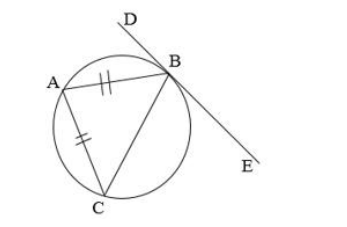
In the given figure, DE is tangent to the circle at a point B. $\Delta \text{ABC}$ is constructed such that A and C are points on the circumference of the given circle, with $\text{AB} = \text{AC}$. If $\angle \text{ABD} = 65^\circ$, then what is $\angle \text{BAC}$? (Figure is not to scale)
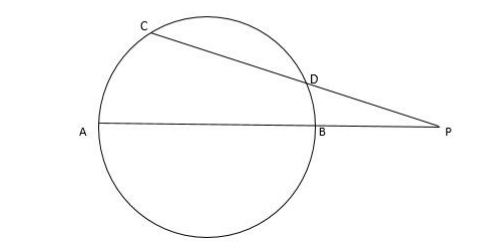
In the given circle, diameter AB is extended to meet chord CD extended at P. If the lengths of the line segments AP, CP and DP are 12 cm, 8 cm and 6 cm, respectively, what is the length of the radius of the circle?
- A point P is 13 cm from the center of a circle. The length of the tangent drawn from P to the circle is 12 cm. Find the radius of the circle.
- AB and CD are two chords of a circle. AB = 6 cm, CD = 8 cm and AB || CD. If the distance between AB and CD is 7 cm and the centre of the circle lies in the interior of the quadrilateral ABCD, then find the radius of the circle (in cm).
Important Questions from Circles, Chords and Tangents
- A circular coin of radius 1 cm is allowed to roll freely on the periphery over a circular disc of radius 10 cm. If the disc has no movement and the coin completes one revolution rolling on the periphery over the disc and without slipping, then what is the number of times the coin rotated about its centre ?
There are two concentric circles. The radii of the two circles are 100 m and 110 m respectively. A wheel of radius 30 cm rolls on the smaller circle and another wheel rolls on the larger circle. After they have completed one revolution, it is found that the two wheels rolled equal number of times
on their respective axes. What is the radius of the other wheel ?- The length of a tangent drawn to a circle of radius 4 cm from a point 5 cm away from the center of the circle is:
- If SA and SB are tangents to a circle from an outside point S, such that SA = 12 cm and angle ASB = 60°. What will the length of chord AB be?
- A chord of length 24 cm is at a distance of 5 cm from the centre of a circle. The radius of the circle is ______ cm.