
In a circle, a diameter AB and a chord PQ (which is not a diameter) intersect each other at X perpendicularly. If AX : BX = 3 : 2 and the radius of the circle is 5 cm, then the length of chord PQ is
4√6 cm
Circle Geometry Problem: Finding Chord Length
This problem involves a circle, a diameter, and a chord that intersect perpendicularly. We are given the ratio of the segments of the diameter formed by the intersection point and the radius of the circle. We need to find the length of the chord.
Understanding the Given Information
- A circle with diameter AB.
- A chord PQ intersects the diameter AB at point X.
- The intersection is perpendicular: AB ⊥ PQ.
- The ratio of the segments of the diameter is AX : BX = 3 : 2.
- The radius of the circle is 5 cm.
Calculating Diameter Segments AX and BX
The radius of the circle is 5 cm. The diameter AB is twice the radius.
Diameter AB = 2 × Radius = 2 × 5 cm = 10 cm.
The diameter AB is divided at point X in the ratio AX : BX = 3 : 2. The total parts are 3 + 2 = 5.
- Length of AX = \(\frac{3}{5}\) × AB = \(\frac{3}{5}\) × 10 cm = 6 cm.
- Length of BX = \(\frac{2}{5}\) × AB = \(\frac{2}{5}\) × 10 cm = 4 cm.
We can check that AX + BX = 6 cm + 4 cm = 10 cm, which is the length of the diameter AB.
Applying Geometric Properties: Perpendicular Diameter and Chord
A key property in circle geometry states that a diameter perpendicular to a chord bisects the chord. Since diameter AB is perpendicular to chord PQ at X, point X is the midpoint of PQ. This means PX = XQ.
Using the Power of a Point Theorem
When two chords (or a chord and a diameter) intersect inside a circle, the products of the segments of each chord are equal. For intersecting segments AB and PQ at point X, the Power of a Point theorem states:
AX × BX = PX × XQ
Since we know AX = 6 cm, BX = 4 cm, and PX = XQ, we can write:
6 cm × 4 cm = PX × PX
\(24 \text{ cm}^2 = \text{PX}^2\)
Calculating the Length of Chord Segment PX
To find PX, we take the square root of PX²:
PX = \(\sqrt{24 \text{ cm}^2}\)
We can simplify the square root of 24:
\(\sqrt{24} = \sqrt{4 \times 6} = \sqrt{4} \times \sqrt{6} = 2\sqrt{6}\)
So, PX = \(2\sqrt{6}\) cm.
Calculating the Length of Chord PQ
Since X is the midpoint of PQ, the length of the chord PQ is twice the length of PX:
PQ = 2 × PX
PQ = 2 × (\(2\sqrt{6}\) cm)
PQ = \(4\sqrt{6}\) cm
Summary of Calculations
| Quantity | Calculation | Value |
|---|---|---|
| Diameter AB | \(2 \times \text{Radius}\) | 10 cm |
| Segment AX | \(\frac{3}{5} \times \text{AB}\) | 6 cm |
| Segment BX | \(\frac{2}{5} \times \text{AB}\) | 4 cm |
| Product AX × BX | \(6 \text{ cm} \times 4 \text{ cm}\) | \(24 \text{ cm}^2\) |
| PX² (using Power of a Point) | AX × BX | \(24 \text{ cm}^2\) |
| Segment PX | \(\sqrt{24 \text{ cm}^2}\) | \(2\sqrt{6}\) cm |
| Chord PQ | \(2 \times \text{PX}\) | \(4\sqrt{6}\) cm |
Thus, the length of chord PQ is \(4\sqrt{6}\) cm.
Revision Table: Key Concepts
| Concept | Description | Relevance to Problem |
|---|---|---|
| Diameter | A chord passing through the center of the circle. Longest chord. | AB is the diameter, used to find its length and segments. |
| Chord | A line segment connecting two points on the circle. | PQ is the chord whose length we need to find. |
| Perpendicular Bisection of Chord | A diameter perpendicular to a chord bisects the chord. | Used to establish PX = XQ. |
| Power of a Point Theorem (Intersecting Chords) | If two chords intersect inside a circle, the product of the segments of one chord equals the product of the segments of the other. | Used to relate AX, BX, PX, and XQ. |
Additional Information: Power of a Point Theorem
The Power of a Point Theorem describes the relationship between line segments created by a line intersecting a circle. When a point X is inside a circle and two chords AB and PQ pass through X, the theorem states that AX × BX = PX × QX. This product AX × BX (or PX × QX) is called the power of point X with respect to the circle. This theorem is very useful in solving problems involving intersecting chords, secants, and tangents.
In our problem, one intersecting line is the diameter AB, and the other is the chord PQ. The perpendicularity simplifies the problem because it guarantees that the chord PQ is bisected at the intersection point X, making PX = XQ. This allows us to use the relationship AX × BX = PX² directly to find the length of the chord segments.
Similar Questions
O is the centre of this circle. Tangent drawn from a point P, touches the circle at Q. If PQ = 24 cm and OQ = 10 cm, then what is the value of OP?
AC is the diameter of a circle dividing the circle into two semicircles. ED is a chord in one semicircle, such that ED is parallel to AC. B is a point on the circumference of the circle in the other semicircle. ∠CBE = 75°. What is the measure (in degrees) of ∠CED?
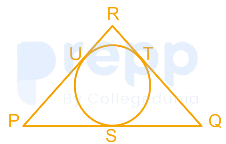
In the given figure, a circle inscribed in ∆PQR touches its sides PQ, QR and RP at points S, T and U, respectively. If PQ = 15 cm, QR = 10 cm, and RP = 12 cm, then find the lengths of PS, QT and RU?
In a circle, AB is the diameter and CD is a chord. AB and CD produced meet at a point P, outside the circle. If PD = 15.3 cm, CD = 11.9 cm and AP = 30.6 cm, then the radius of the circle is:
Point P lies outside a circle with centre O. Tangents PA and PB are drawn to meet the circle at A and B respectively. If ∠APB = 80°, then ∠OAB is equal to:
ΔABC is incribed in a circle with center O, such that ∠ACB = 115°, O is joined to A. What is the measure of ∠OAB?
In the given figure, if AB = 10 cm, CD = 7 cm, SD = 4 cm and AS = 5 cm, then BC = ?
PQ and RS are common tangents to two circles intersecting at A and B. AB, when produced both sides, meet the tangents PQ and RS at X and Y, respectively. If AB = 3 cm, XY = 5 cm, then PQ (in cm) will be
The vertices of ΔPQR lie on a circle with centre O, SR is a tangent to the circle at the point R. If QR bisects the ∠ORS, then what is the measures of ∠RPQ?
In a circle with centre O, an arc ABC subtends an angle of 140° at the centre of the circle. The chord AB is produced to point P. Then ∠CBP is equal to:
Important Questions from Circles, Chords and Tangents
- A circular coin of radius 1 cm is allowed to roll freely on the periphery over a circular disc of radius 10 cm. If the disc has no movement and the coin completes one revolution rolling on the periphery over the disc and without slipping, then what is the number of times the coin rotated about its centre ?
There are two concentric circles. The radii of the two circles are 100 m and 110 m respectively. A wheel of radius 30 cm rolls on the smaller circle and another wheel rolls on the larger circle. After they have completed one revolution, it is found that the two wheels rolled equal number of times
on their respective axes. What is the radius of the other wheel ?- The length of a tangent drawn to a circle of radius 4 cm from a point 5 cm away from the center of the circle is:
- If SA and SB are tangents to a circle from an outside point S, such that SA = 12 cm and angle ASB = 60°. What will the length of chord AB be?
- In a circle, two chords of lengths x and y subtend the angles of $60^{\circ}$ and $90^{\circ}$ at the center respectively. Which of the following is correct in this scenario?



