
AC is the diameter of a circle dividing the circle into two semicircles. ED is a chord in one semicircle, such that ED is parallel to AC. B is a point on the circumference of the circle in the other semicircle. ∠CBE = 75°. What is the measure (in degrees) of ∠CED?
15°
The question asks us to find the measure of angle CED in a specific circle configuration. We are given a circle with diameter AC. A chord ED is drawn in one semicircle and is parallel to the diameter AC. A point B is located on the circumference in the other semicircle. We know that the angle CBE is 75 degrees.
Properties of Parallel Chord and Diameter
A key property arises because the chord ED is parallel to the diameter AC. When a chord is parallel to a diameter (or another chord), it subtends equal arcs between the parallel lines. Therefore, the arc AE and the arc CD have equal measures.
- Given ED || AC, it follows that the measure of arc AE = measure of arc CD.
Calculating Arc CE Measure
We are given that angle CBE = 75°. This angle is an inscribed angle because point B lies on the circumference of the circle. This angle subtends the arc CE.
The measure of an inscribed angle is half the measure of its subtended arc. Let O be the center of the circle. The central angle subtended by arc CE is $\angle COE$. The relationship is:
$$ \angle CBE = \frac{1}{2} \times \text{measure of arc CE} $$Substitute the given value of $\angle CBE$:
$$ 75^\circ = \frac{1}{2} \times \text{measure of arc CE} $$To find the measure of arc CE, we multiply both sides of the equation by 2:
$$ \text{measure of arc CE} = 2 \times 75^\circ = 150^\circ $$So, the measure of arc CE is 150 degrees.
Finding the Measure of Arc CD
Since AC is the diameter, it represents a straight line ($180^\circ$). Let's represent the positions of points on the circle using angles measured counterclockwise from point C (at $0^\circ$). Point A is then at $180^\circ$.
Since arc CE measures $150^\circ$, the position of point E can be considered as $150^\circ$ from C.
The condition ED || AC means that points E and D are symmetrically positioned with respect to the perpendicular bisector of AC (which is the line passing through the center O and perpendicular to AC). If E is at $150^\circ$, D must be such that the arc AE equals arc CD.
The measure of arc AE is the difference between the angle for A ($180^\circ$) and the angle for E ($150^\circ$):
$$ \text{measure of arc AE} = 180^\circ - 150^\circ = 30^\circ $$Since arc AE = arc CD, we have:
$$ \text{measure of arc CD} = 30^\circ $$Alternatively, D's position would be $180^\circ - 150^\circ = 30^\circ$ from C.
Arc CD is the arc from C ($0^\circ$) to D ($30^\circ$), so its measure is $30^\circ - 0^\circ = 30^\circ$. This confirms our calculation.
Finding the Measure of Angle CED
The angle we need to find is CED. This is an inscribed angle that subtends the arc CD.
We found that the measure of arc CD is 30 degrees.
Using the relationship between an inscribed angle and its subtended arc:
$$ \angle CED = \frac{1}{2} \times \text{measure of arc CD} $$Substitute the measure of arc CD:
$$ \angle CED = \frac{1}{2} \times 30^\circ $$ $$ \angle CED = 15^\circ $$Thus, the measure of angle CED is 15 degrees.
Similar Questions
O is the centre of this circle. Tangent drawn from a point P, touches the circle at Q. If PQ = 24 cm and OQ = 10 cm, then what is the value of OP?
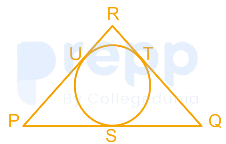
In the given figure, a circle inscribed in ∆PQR touches its sides PQ, QR and RP at points S, T and U, respectively. If PQ = 15 cm, QR = 10 cm, and RP = 12 cm, then find the lengths of PS, QT and RU?
In a circle, AB is the diameter and CD is a chord. AB and CD produced meet at a point P, outside the circle. If PD = 15.3 cm, CD = 11.9 cm and AP = 30.6 cm, then the radius of the circle is:
Point P lies outside a circle with centre O. Tangents PA and PB are drawn to meet the circle at A and B respectively. If ∠APB = 80°, then ∠OAB is equal to:
ΔABC is incribed in a circle with center O, such that ∠ACB = 115°, O is joined to A. What is the measure of ∠OAB?
In the given figure, if AB = 10 cm, CD = 7 cm, SD = 4 cm and AS = 5 cm, then BC = ?
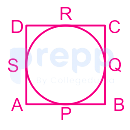
PQ and RS are common tangents to two circles intersecting at A and B. AB, when produced both sides, meet the tangents PQ and RS at X and Y, respectively. If AB = 3 cm, XY = 5 cm, then PQ (in cm) will be
In a circle, a diameter AB and a chord PQ (which is not a diameter) intersect each other at X perpendicularly. If AX : BX = 3 : 2 and the radius of the circle is 5 cm, then the length of chord PQ is
The vertices of ΔPQR lie on a circle with centre O, SR is a tangent to the circle at the point R. If QR bisects the ∠ORS, then what is the measures of ∠RPQ?
In a circle with centre O, an arc ABC subtends an angle of 140° at the centre of the circle. The chord AB is produced to point P. Then ∠CBP is equal to:
Important Questions from Circles, Chords and Tangents
- A circular coin of radius 1 cm is allowed to roll freely on the periphery over a circular disc of radius 10 cm. If the disc has no movement and the coin completes one revolution rolling on the periphery over the disc and without slipping, then what is the number of times the coin rotated about its centre ?
There are two concentric circles. The radii of the two circles are 100 m and 110 m respectively. A wheel of radius 30 cm rolls on the smaller circle and another wheel rolls on the larger circle. After they have completed one revolution, it is found that the two wheels rolled equal number of times
on their respective axes. What is the radius of the other wheel ?- The length of a tangent drawn to a circle of radius 4 cm from a point 5 cm away from the center of the circle is:
- If SA and SB are tangents to a circle from an outside point S, such that SA = 12 cm and angle ASB = 60°. What will the length of chord AB be?
- In a circle, two chords of lengths x and y subtend the angles of $60^{\circ}$ and $90^{\circ}$ at the center respectively. Which of the following is correct in this scenario?



