In a circle, the angle subtended by a diameter at any point on the circle is:
Right angle
By the theorem of angles in a semicircle, the angle subtended by a diameter of a circle at any point on the circle (other than the two endpoints of the diameter) is always a right angle.
This is a direct consequence of the fact that the angle in a semicircle is \(90^\circ\), since the diameter subtends an arc of \(180^\circ\) at the centre, and the angle at the circumference is half the angle at the centre.
Hence, the angle subtended is a right angle.
Similar Questions
A circular field has a radius of 14 m. A uniform path of width 7 m is constructed all around the field on the outside. Find the area of the path. (Take π = 22/7)
Find the angle between the radius and the tangent at the point of contact.
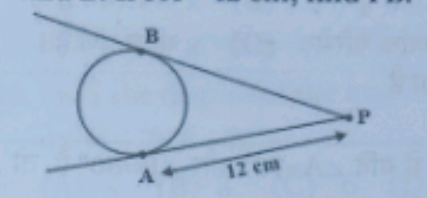
From an external point P, two tangents PA and PB are drawn to a circle, touching at A and B. If PA = 12 cm, find PB.
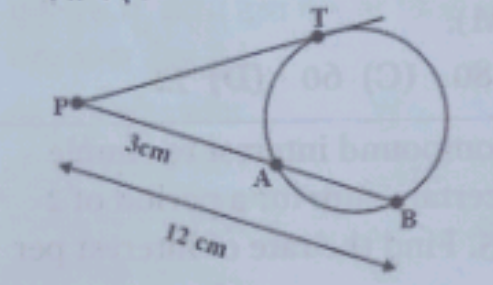
If PA = 3 cm and PB = 12 cm, find PT.
Important Questions from Circles
The sum of the radius and diameter of a circle is 84 cm. What is the circumference of this circle?
The tangent at a point C of a circle and diameter AB when extended intersect at D, if ∠DCA = 110°, then ∠CBA is equal to
The equation of a circle with diameters are 2x - 3y + 12 = 0 and x + 4y - 5 = 0 and area of 154 sq. units is
The internal center of similitude of two circles $ (x - 1)^2 + (y - 3)^2 = 4 $ and $ (x + 5)^2 + (y - 9)^2 = 16 $ is
The inner circumference of a circular race track 14 cm wide is 440 cm. Find the radius of the outer circle.