
In a certain code language, 'DRAWING' is written as 'CQZVHMF' and 'TURQUOISE' is written as ' STQPTNHRD', how will 'COLOR' be written in that language?
BNKNQ
Decoding the Code Language Pattern
The question asks us to find the coded form of the word 'COLOR' based on the pattern observed in the given examples: 'DRAWING' is coded as 'CQZVHMF' and 'TURQUOISE' is coded as 'STQPTNHRD'. We need to analyze the relationship between the letters in the original words and their corresponding coded forms.
Analyzing the Coding Pattern
Let's look at the first example, 'DRAWING' and its code 'CQZVHMF'. We can compare the letters position by position:
- D in DRAWING corresponds to C in CQZVHMF. C is the letter before D.
- R in DRAWING corresponds to Q in CQZVHMF. Q is the letter before R.
- A in DRAWING corresponds to Z in CQZVHMF. Z is the letter before A (wrapping around the alphabet).
- W in DRAWING corresponds to V in CQZVHMF. V is the letter before W.
- I in DRAWING corresponds to H in CQZVHMF. H is the letter before I.
- N in DRAWING corresponds to M in CQZVHMF. M is the letter before N.
- G in DRAWING corresponds to F in CQZVHMF. F is the letter before G.
The pattern seems to be shifting each letter one position backward in the English alphabet. Let's verify this pattern with the second example, 'TURQUOISE' and 'STQPTNHRD'.
- T → S (S is before T)
- U → T (T is before U)
- R → Q (Q is before R)
- Q → P (P is before Q)
- U → T (T is before U)
- O → N (N is before O)
- I → H (H is before I)
- S → R (R is before S)
- E → D (D is before E)
The pattern holds true for the second example as well. Each letter in the original word is replaced by the letter that comes immediately before it in the alphabet.
Applying the Pattern to 'COLOR'
Now, we apply the identified pattern to the word 'COLOR'. We need to find the letter that comes before each letter in 'COLOR'.
- For C: The letter before C is B.
- For O: The letter before O is N.
- For L: The letter before L is K.
- For O: The letter before O is N.
- For R: The letter before R is Q.
Combining these coded letters, we get 'BNKNQ'.
Resulting Code for COLOR
Based on the analysis of the coding language pattern, the word 'COLOR' is written as 'BNKNQ'.
Comparing with Options
Let's compare our result 'BNKNQ' with the given options:
- Option 1: BNKNQ
- Option 2: BMKMQ
- Option 3: ANKNQ
- Option 4: AMKMQ
Our calculated code 'BNKNQ' matches Option 1.
| Original Word | Letter | Rule (\( \text{Letter} - 1 \)) | Coded Letter |
|---|---|---|---|
| COLOR | C | C - 1 | B |
| O | O - 1 | N | |
| L | L - 1 | K | |
| O | O - 1 | N | |
| R | R - 1 | Q |
Conclusion on Code Language
The code language used follows a simple substitution cipher where each letter is replaced by the letter preceding it in the alphabet. This consistent rule was applied to 'COLOR' to find its coded form.
Revision Table: Code Language Mapping
| Original Letter | Coded Letter (\( \text{Previous Letter} \)) |
|---|---|
| A | Z |
| B | A |
| C | B |
| D | C |
| ... | ... |
| R | Q |
| S | R |
| T | S |
| U | T |
| V | U |
| W | V |
| ... | ... |
| Z | Y |
Additional Information: Substitution Ciphers and Code Languages
The type of code language used in this problem is a form of substitution cipher. In a substitution cipher, each letter or group of letters in the original message is replaced by another letter, number, or symbol according to a consistent rule.
- Caesar Cipher: The specific cipher here, where each letter is shifted by a fixed number of positions (in this case, -1), is a type of Caesar cipher. A standard Caesar cipher shifts letters by a fixed number of positions down the alphabet. Shifting by -1 is equivalent to shifting by +25 (or 25 positions forward).
- Simple Substitution: More broadly, simple substitution ciphers replace each letter of the alphabet with another letter or symbol. The key is the mapping of each original letter to its replacement. In this case, the key is simply "each letter is replaced by the one before it".
- Cryptanalysis: Analyzing code languages like this often involves looking for patterns, frequency analysis of letters, or using known plaintext (like the examples given in the question) to deduce the substitution rule.
Understanding these basic coding principles is fundamental in verbal reasoning and pattern recognition questions. Practice with different types of shifts and substitutions can help in quickly identifying the rule in such code language problems.
Similar Questions
Which two numbers and two signs should be interchanged to make the given equation correct?
5 + 44 - 8 × 25 = 203
Select the set in which the numbers are related in the same way as are the numbers of the following set.
(NOTE: Operations should be performed on the whole numbers, without breaking down the numbers into its constituent digits.)
(60, 5, 6)
(48, 8, 3)
A & B means ‘A is the son of B’
A # B means ‘A is the sister of B’
A @ B means ‘A is the brother of B’
A % B means ‘A is the father of B’
A - B means ‘A is the daughter of B’
A * B means ‘A is the wife of B’
If C # D @ E % Z & L # M - N * P, then how is Z related to N?
Select the figure that will come next in the following figure series.

Select the figure from among the given options that can replace the question mark (?) in the following series.

Read the given statements and conclusions carefully. Assuming that the information given in the statements is true, even if it appears to be at variance with commonly known facts, decide which of the given conclusions logically follow(s) from the statements.
Statements:
All pens are plates.
All plates are trays.
Some trays are boxes.
Conclusions:
I. Some boxes are plates.
II. Some trays are pens.
III. Some boxes are pens.
IV. No tray is a plate.
In the following question, select the missing number from the given series.
69, 70, 73, 78, 85, ?
If A × B means that A is the father of B, A + B means that A is the mother of B, A ÷ B means that A is the brother of B then which of the following expression shows that A is the paternal uncle of C?
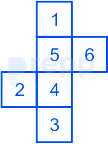
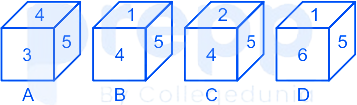
Select the cube that can be formed by folding the given sheet along the lines.
Three of the following letter-clusters are alike in some manner and hence form a group. Which letter-cluster does not belong to that group?
Important Questions from Miscellaneous
Which gas shields the surface of the earth from ultraviolet radiation from the sun?
Which event is marked as an Intangible Cultural Heritage of Humanity by UNESCO?
Who has been conferred with the rank of the Commander of the Order of the British Empire in 2018?
Who directead the film ‘Bhuvan Shome’?
The book “In my mother’s house” is written by _______



