If the fraction of surface sites occupied by an adsorbate is given by \(\frac{V}{V_m}\), the equation for adsorption isotherm is :
\(\frac{1}{V} = \frac{1}{PbV_m} + \frac{1}{V_m}\)
The Langmuir adsorption isotherm describes monolayer adsorption on a surface of identical, independent sites. Writing the fractional coverage as \(\theta = \frac{V}{V_m}\), where \(V_m\) is the volume needed for a complete monolayer, the isotherm is
\(\theta = \frac{bP}{1 + bP}\), so \(\frac{V}{V_m} = \frac{bP}{1 + bP}\).
Rearrange to the linear form. Invert both sides:
\(\frac{V_m}{V} = \frac{1 + bP}{bP} = \frac{1}{bP} + 1\).
Divide through by \(V_m\):
\(\frac{1}{V} = \frac{1}{PbV_m} + \frac{1}{V_m}\).
This is the useful working form: plotting \(\frac{1}{V}\) against \(\frac{1}{P}\) gives a straight line of slope \(\frac{1}{bV_m}\) and intercept \(\frac{1}{V_m}\), from which both the monolayer capacity and the adsorption equilibrium constant are obtained. The monolayer capacity in turn gives the surface area of the adsorbent.
Checking the limits confirms the expression. At low pressure, \(bP \ll 1\) and \(\theta \approx bP\), so coverage is proportional to pressure. At high pressure, \(bP \gg 1\) and \(\theta \to 1\) — the surface saturates at one monolayer, which is the defining assumption of the model.
The other options are not rearrangements of the isotherm at all; only one has \(\frac{1}{V}\) isolated with the correct two terms on the right.
Hence the isotherm is \(\frac{1}{V} = \frac{1}{PbV_m} + \frac{1}{V_m}\).
Similar Questions
The property measured in derivative thermogravimetric analysis (DTG) is :
Analysis of four different samples of an alloy yielded 12.12, 12.14, 12.10 and 12.22% of metal. The mean deviation of the result is :
For the first order consecutive reaction :
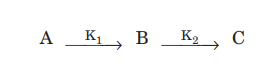
Which of the following statement is incorrect ?
A given reaction is fitted into the following Arrhenius form :
K2 = 6.0 × 10¹⁴ (S-1) . exp \(\left[-\frac{104.4\ (\mathrm{kJ\,mol^{-1}})}{RT}\right]\)
Value of the rate constant at very high temperature would be :
The following half cell represents, normal hydrogen electrode (NHE) :
If, we discharge the electrochemical cell rapidly, then :
E° value for various ions are as follows :
E°(MnO4-) = +1.51 V
E°(Ag/Ag+) = +0.7996 V
E°(Au/Au+) = +1.692 V
E°(Zn/Zn2+) = -0.761 V
Based on this data, permaganate can be used to oxidize :
Vapour pressure of 0.5 molal solution of non-volatile solute in organic solvent at 30°C would be :
(Given : vapour pressure of pure organic solvent is 100 torr; the molecular weight of organic solvent is 100 g mol-1).
Molar conductance of 0.01 M acetic acid was found to be 16 × 10-4 S m2 mol-1 at 30°C. Molar conductance of H+ and CH3COO- ions at infinite dilution are 350 × 10-4 S m2 mol-1 and 50 × 10-4 S m2 mol-1, respectively at same temperature. What percentage of acetic acid is dissociated at that concentration ?
The variation of Cp with pressure at constant temperature is given by :
Important Questions from Thermodynamics
Two blocks of ice when pressed together join to form one block because
The ratio C p/C vof the specific heats at constant pressure and volume of a monoatomic ideal gas in two dimensions is
The total number of phonon modes in a solid of volume V is \(\int_{\rm{0}}^{{\rm{ω_ D}}} {{\rm{g}}\left( {\rm{ω }} \right)\,} {\rm{dω }}\) = 3N, where N is the number of primitive cells, ω Dis the Debye frequency and density of photon modes is g( ω ) = AV ω2 (with A > 0 a constant). If the density of the solid doubles in a phase transition, the Debye temperature θ D, will
The dispersion relation of a gas of non-interacting bosons in d dimensions is E(k) = ak s, where a and s are positive constants. Bose-Einstein condensation will occur for all values of
Example of thermoplastic among the following is