
Direction : Consider the following for the two (02) items that follow : The budget allocations represented in a pie diagram under five different heads A, B, C, D and E are respectively 40%, 18%, 9%, 25% and 8%. The total budget allocation is ₹300.4 lakhs.
How much amount will be increased on A if the total budget is increased by three times?
₹240.32 lakhs
Understanding Budget Allocation and Increase
The problem provides us with budget allocations across five different heads (A, B, C, D, E) as percentages of the total budget. We are given the total budget amount and asked to find the increase in the amount allocated to head A if the total budget is increased by three times.
Here is the breakdown of the given information:
- Total budget allocation: ₹300.4 lakhs
- Allocation percentage for head A: 40%
- New total budget: Increased by three times the original total budget.
We need to calculate the original amount allocated to head A, then the new total budget, the new amount allocated to head A, and finally the increase in the amount for head A.
Step 1: Calculate the original amount allocated to head A
The amount allocated to head A is 40% of the total budget.
Original Amount for A = 40% of ₹300.4 lakhs
Using LaTeX for the calculation:
\( \text{Original Amount for A} = \frac{40}{100} \times 300.4 \text{ lakhs} \)
\( \text{Original Amount for A} = 0.40 \times 300.4 \text{ lakhs} \)
\( \text{Original Amount for A} = 120.16 \text{ lakhs} \)
So, the original amount allocated to head A is ₹120.16 lakhs.
Step 2: Calculate the new total budget
The total budget is increased by three times. This means the new total budget will be the original total budget plus three times the original total budget, or simply four times the original total budget. However, the phrasing "increased by three times" often implies the new amount is the original amount multiplied by three. Let's assume it means the new budget is 3 times the original budget.
New Total Budget = 3 \(\times\) Original Total Budget
New Total Budget = 3 \(\times\) ₹300.4 lakhs
New Total Budget = ₹901.2 lakhs
Let's consider the alternative interpretation: "increased *by* three times" means the increase is three times the original, making the new total four times the original. If the question meant "increased *to* three times", then the new total is 3 * Original. Given the options, the interpretation "increased to three times" (i.e., new total is 3x the original) seems more likely to yield one of the answers. We will proceed with the interpretation that the new total budget is 3 times the original total budget.
Step 3: Calculate the new amount allocated to head A
The percentage allocation for head A remains the same (40%), but it is now applied to the new total budget.
New Amount for A = 40% of New Total Budget
New Amount for A = 40% of ₹901.2 lakhs
Using LaTeX for the calculation:
\( \text{New Amount for A} = \frac{40}{100} \times 901.2 \text{ lakhs} \)
\( \text{New Amount for A} = 0.40 \times 901.2 \text{ lakhs} \)
\( \text{New Amount for A} = 360.48 \text{ lakhs} \)
The new amount allocated to head A is ₹360.48 lakhs.
Alternatively, since the percentage allocation for A (40%) remains constant and the total budget is multiplied by 3, the amount allocated to A will also be multiplied by 3.
New Amount for A = 3 \(\times\) Original Amount for A
New Amount for A = 3 \(\times\) ₹120.16 lakhs
New Amount for A = ₹360.48 lakhs
Both methods give the same new amount for A.
Step 4: Calculate the increase in the amount for head A
The increase in the amount for head A is the difference between the new amount and the original amount allocated to head A.
Increase in A = New Amount for A - Original Amount for A
Increase in A = ₹360.48 lakhs - ₹120.16 lakhs
Using LaTeX for the calculation:
\( \text{Increase in A} = 360.48 - 120.16 \text{ lakhs} \)
\( \text{Increase in A} = 240.32 \text{ lakhs} \)
The amount increased on head A is ₹240.32 lakhs.
Alternatively, since the new amount for A is 3 times the original amount for A, the increase is the new amount minus the original amount, which is 3 \(\times\) Original - 1 \(\times\) Original = 2 \(\times\) Original.
Increase in A = 2 \(\times\) Original Amount for A
Increase in A = 2 \(\times\) ₹120.16 lakhs
Increase in A = ₹240.32 lakhs
Both calculations confirm the increase.
Summary of Calculations
| Description | Amount (₹ lakhs) |
|---|---|
| Original Total Budget | 300.4 |
| Original Allocation for A (40%) | 120.16 |
| New Total Budget (3 \(\times\) Original) | 901.2 |
| New Allocation for A (40% of New Total) | 360.48 |
| Increase in Allocation for A (New - Original) | 240.32 |
The amount that will be increased on A if the total budget is increased by three times is ₹240.32 lakhs.
Revision Table: Budget Allocation Concepts
| Concept | Explanation | Formula/Calculation Example |
|---|---|---|
| Percentage Allocation | A part of the total budget represented as a percentage. | Amount = (Percentage / 100) \(\times\) Total Budget |
| Calculating Amount from Percentage | Multiplying the total by the percentage (in decimal form). | 40% of 300.4 = 0.40 \(\times\) 300.4 = 120.16 |
| Budget Increase | The new budget is higher than the original. If increased 'by' X times, New Budget = Original + X * Original. If increased 'to' X times, New Budget = X * Original. Context is key. | If increased 'to' 3 times: New Budget = 3 \(\times\) Original Budget |
| Calculating Increase in Amount | The difference between the new allocated amount and the original allocated amount. | Increase = New Amount - Original Amount |
Additional Information: Percentage Change and Scaling
When a total value increases by a certain factor and a component of that total is always a fixed percentage of the total, that component will also increase by the same factor.
In this problem:
- Original Total Budget = T
- Original Amount for A = 40% of T = 0.40 \(\times\) T
- New Total Budget = 3 \(\times\) T
- New Amount for A = 40% of (3 \(\times\) T) = 0.40 \(\times\) 3 \(\times\) T = 3 \(\times\) (0.40 \(\times\) T) = 3 \(\times\) Original Amount for A
The increase in the amount for A is:
Increase = New Amount for A - Original Amount for A
Increase = (3 \(\times\) Original Amount for A) - Original Amount for A
Increase = (3 - 1) \(\times\) Original Amount for A
Increase = 2 \(\times\) Original Amount for A
This shows that the *increase* itself is twice the original amount allocated to A. We calculated the original amount for A as ₹120.16 lakhs. Therefore, the increase is 2 \(\times\) ₹120.16 lakhs = ₹240.32 lakhs. This confirms our step-by-step calculation.
Similar Questions
How much less amount is allocated to A and C together as compared to B, D and E together?
A pie chart is drawn for the following data:
Sector
Percentage
Agriculture and Rural development
12.9
Irrigation
12.5
Energy
27.2
Industry and Minerals
15.4
Transport and communication
15.9
Social services
16.1
What is the angle (approximately) subtended by the social services sector at the centre of the circle?
The pie diagrams on the monthly expenditure of two families A and B are drawn with radii of two circles taken in the ratio 16 : 9 to compare their expenditures.
Which one of the following is the appropriate data used for the above mentioned pie diagram?Which one of the following is not correct?
The proportion of various items in a pie diagram is proportional to theIn a pie diagram, there are four slices with angles 150°, 90°, 60° and 60°. A new pie diagram is formed by deleting one of the slices having angle 60° in the given pie diagram. In the new pie diagram
There are two categories of employees in 2019 whose total strength remained the same in 2020. What are these two categories ?
In which one of the following categories of employees, the percentage change in number of employees in 2020 was maximum as compared to 2019?
What was the percentage increase of category-E employees in 2020 as compared to that in 2019 ?
There are two categories of employees whose strength increased/decreased by same percentage in 2020. What are the two categories ?
Important Questions from Pie Chart
Study the following pie-charts carefully to answer the questions.
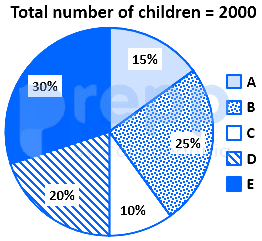
If 70 percent children from village D go to school then what is the number of children attending school from village D ?
Study the following pie-charts carefully to answer the questions.Percentage break-up of number of children in five different villages
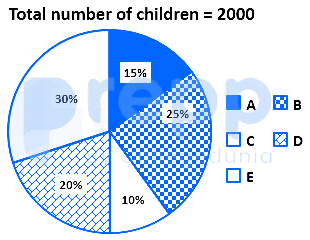
What is the respective ratio of total number of children from village A to village C ?
Study the following pie-charts carefully to answer the questions.Percentage break-up of number of children in five different villages
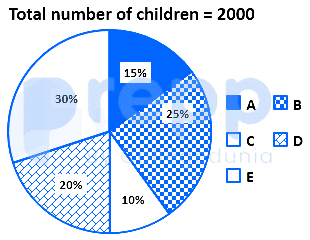
What is the total number of children in villages B and E ?
Study the chart and answer the question based, on the pie chart.The pie chart is given below shows expenditures incurred by a family on various items and savings in a month. Savings of the family is ₹ 8,000 in a month.
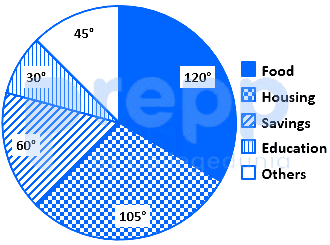
What is the total expenditure of the family for the month?
Study the chart and answer the question based, on the pie chart.The pie chart given below shows expenditures incurred by a family on various items and savings in a month. Savings of the family is ₹ 8,000 in a month.
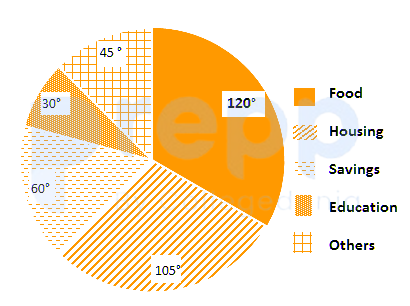
How much more amount is spent on food than on housing?



