Assertion A : Generally, 3d transition metals have high melting points.
Reason R : Involvement of 3d-electrons in addition to 4s-electrons in the interatomic metallic bonding.
In light of the above statements, choose the most appropriate answer from the options given below:
Assertion A: High Melting Points of 3d Transition Metals
Statement A asserts that 3d transition metals generally exhibit high melting points. This is a characteristic property observed in most transition metals due to the nature of their metallic bonding.
Reason R: Electron Involvement in Metallic Bonding
Statement R explains the reason for the high melting points by highlighting the involvement of both 3d and 4s electrons in metallic bonding. In transition metals, the unpaired d-electrons contribute significantly to the strength of the metallic bonds, in addition to the delocalized 4s electrons.
- The metallic bond arises from the electrostatic attraction between positively charged metal ions and a 'sea' of delocalized electrons.
- In 3d transition metals, the d-orbitals are relatively localized but can participate in bonding through overlapping orbitals between adjacent atoms.
- This extensive sharing and delocalization, involving both 4s and 3d electrons, leads to strong interatomic forces.
- Stronger interatomic forces require more energy to overcome, resulting in higher melting points.
Conclusion on Statements A and R
Both Assertion A and Reason R are factually correct. Furthermore, Reason R provides a valid and direct explanation for Assertion A. The enhanced strength of metallic bonding, due to the participation of 3d electrons, is the primary reason for the high melting points observed in 3d transition metals.
Therefore, the most appropriate answer is that both statements are correct, and Reason R is the correct explanation for Assertion A.
Correct Option: 4. Both A and R are correct and R is the correct explanation of A.
Similar Questions
Match List I with List II :
List I (Transition metal/compound) List II (Catalytic Role) A. $V_2O_5$ I. Preparation of ammonia from $N_2/H_2$ mixture B. Fe II. Polymerisation of alkynes C. $PdCl_2$ III. Preparation of $H_2SO_4$ from $SO_2$ D. Ni complex IV. Oxidation of ethyne to ethanal Choose the correct answer :
- Identify the incorrect statement from the following :
Identify the correct statement about $ClF_3$ from the following options :
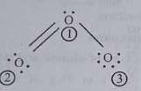
The correct formal charges on oxygen atoms numbered 2, 1 and 3 respectively in ozone are :
- Match the species in List I with their geometry in List II
List I List II A. $PCl_5$ I. Tetrahedral B. $BrF_5$ II. Square Planar C. $BF_4^-$ III. Trigonal bipyramidal D. $[Ni(CN)_4]^{2-}$ IV. Square pyramidal
Choose the correct answer from the options given below: - Given below are two statements : One is labelled as Assertion A and the other is labelled as Reason R.
Assertion A : The first ionization enthalpy of O is lower than that of N and F.
Reason R : The loss of an electron from O leads to stable half-filled p orbital.
In light of the above statements, choose the most appropriate answer from the options given below: - According to crystal field theory, the correct order of ligands with respect to their decreasing order of field strength is
- Given below are two statements:
Statement-I : $[Fe(ox)_3]^{3-}$ is chiral.
Statement-II : $trans-[Cr(H_2O)_2(ox)_2]^-$ is chiral.
(Given : $oxH_2 = HOOC-COOH$)
In light of the above statements, choose the most appropriate answer from the options given below: - Given below are two statements:
Statement-I : Heating NaCl with concentrated $H_2SO_4$ and $MnO_2$ results in oxidation of Mn.
Statement-II : Heating NaI with concentrated $H_2SO_4$ and $MnO_2$ results in reduction of Mn.
In light of the above statements, choose the most appropriate answer from the options given below: - The highest occupied molecular orbital for $Ne_2$ is
Important Questions from Inorganic Chemistry
- A chromium complex with a formula $\text{CrCl}_3\cdot 6\text{H}_2\text{O}$ has a spin only magnetic moment value of $3.87 \text{ BM}$ and its solution conductivity corresponds to $1 : 2$ electrolyte. $2.75 \text{ g}$ of the complex solution was initially passed through a cation exchanger. The solution obtained after the process was reacted with excess of $\text{AgNO}_3$. The amount of $\text{AgCl}$ formed in the above process is _____ g. (Nearest integer)
[Given: Molar mass in $\text{g mol}^{-1}$ $\text{Cr} : 52; \text{Cl}: 35.5, \text{Ag}: 108, \text{O}: 16, \text{H}: 1$] - Consider the following reactions :
$\text{NaCl} + \text{K}_2\text{Cr}_2\text{O}_7 + \text{H}_2\text{SO}_4 \rightarrow \text{A} + \text{KHSO}_4 + \text{NaHSO}_4 + \text{H}_2\text{O}$
$\text{A} + \text{NaOH} \rightarrow \text{B} + \text{NaCl} + \text{H}_2\text{O}$
$\text{B} + \text{H}_2\text{SO}_4 + \text{H}_2\text{O}_2 \rightarrow \text{C} + \text{Na}_2\text{SO}_4 + \text{H}_2\text{O}$
In the product 'C', 'X' is the number of $\text{O}_2^{2-}$ units, 'Y' is the total number oxygen atoms present and 'Z' is the oxidation state of Cr. The value of X + Y + Z is ____________. - Identify the metal ions among $\text{Co}^{2+}, \text{Ni}^{2+}, \text{Fe}^{2+}, \text{V}^{3+}$ and $\text{Ti}^{2+}$ having a spin-only magnetic moment value more than $3.0\text{ BM}$. The sum of unpaired electrons present in the high spin octahedral complexes formed by those metal ions is __________.
The crystal field splitting energy of $[\text{Co(oxalate)}_3]^{3-}$ complex is '$n$' times that of the $[\text{Cr(oxalate)}_3]^{3-}$ complex. Here '$n$' is ___________. (Assume $\Delta_o >> P$)
- Which of the following is the structure of pyrosulphuric acid?