Find the area of the shaded region: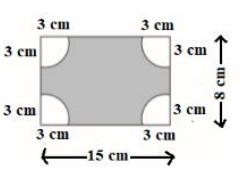
\(\frac{642}{7} \text{ cm}^2\)
\(\dfrac{642}{7}\ \text{cm}^2\) is correct.
The area of a shaded region is found by taking the area of the complete outer figure and subtracting the areas of the unshaded parts shown in the diagram.
Rectangular or triangular parts use \(l \times b\) or \(\dfrac{1}{2} \times b \times h\), and circular parts use \(\pi r^2\) (or a fraction of it for a semicircle or quadrant) with \(\pi = \dfrac{22}{7}\).
Because \(\pi = \dfrac{22}{7}\) is used, the result has denominator 7; with the dimensions in the figure, the shaded area comes to \(\dfrac{642}{7}\ \text{cm}^2\).
Similar Questions
- 4 angles of a pentagon are $70^\circ$, $110^\circ$, $135^\circ$ and $95^\circ$. Find the measure of the fifth angle of the pentagon.
- If the perimeter of a square is 20 cm, then what is its area?
- If the difference between the exterior and the interior angles of a regular polygon is $60^{\circ}$, with an interior angle being greater than the corresponding exterior angle, then find the number of sides of the polygon.
- Find the area of an equilateral triangle whose perimeter is 24 cm.
- The area of the greatest circle that can be inscribed inside a square of side 21cm is:
- The floor of a hall is rectangular. Its length is 30 m and breadth is 24 m. How many carpets of size 6m $\times$ 4m are required to cover it?
The sum of all interior angles of a regular polygon is 1800°. How many diagonals does the polygon have?
The difference between the measure of an interior angle and an exterior angle of a regular polygon is 100°. What is the number of sides of the polygon?
- The length of a rectangular plot is twice its breadth and the length of its diagonal is $6\sqrt{5}$ m. The perimeter of the plot is ______.
- The length of each side of a regular hexagon is $2\sqrt{3} \text{ cm}$. What is the area of the given hexagon?
Important Questions from Plane Figures
If the area of a square is 625 cm 2, then what is the perimeter of the square?
The perimeter of a semi circle is 25.7 cm. What is its diameter (in cm)? (π = 3.14)
The area of an isosceles right angled triangle is 121 cm 2. Find its hypotenuse.
- In Δ ABC, length of perpendicular from A to BC is 15 cm and BC = 8 cm and AC = 24 cm, then find the length of perpendicular from B to AC.
Two sides of a triangle are of length 5 cm and 1.5 cm. The length of third side of the triangle cannot be