Extension Joints and Principal Stress Orientation
Extension joints are fractures that typically form in response to tensile stresses within a material or rock mass. Understanding their orientation requires knowledge of the principal stress directions.
Principal Stress Concepts
The principal stresses ($\sigma_1$, $\sigma_2$, $\sigma_3$) represent the maximum, intermediate, and minimum normal stresses acting at a point. These stresses are oriented perpendicular to three mutually orthogonal planes, known as the principal planes.
- $\sigma_1$: Maximum principal stress
- $\sigma_2$: Intermediate principal stress
- $\sigma_3$: Minimum principal stress
Joint Formation Mechanism
Extension joints develop perpendicular to the direction experiencing the least compression or the greatest tension. This direction corresponds to the minimum principal stress ($\sigma_3$).
- When $\sigma_3$ is tensile (or the least compressive), it indicates the direction where the material is most likely to pull apart.
- Fractures, such as extension joints, form parallel to the planes of maximum shear stress and perpendicular to the minimum principal stress direction.
Therefore, extension joints are oriented perpendicular to the minimum principal stress ($\sigma_3$).
Similar Questions
- Strike direction and dip angle are measured in
- A geological cross-section, drawn through strike line of uniformly dipping beds, shows the bedding traces as a set of lines that are
Important Questions from Joints And Faults
- Which one of the following predicts the correct tectonic settings for development of the positive flower structure and the negative flower structure?
- Which one of the following is not typically associated with strike-slip faults?
- Which one of the following statements is correct?
- Shortening in the Earth's crust is typically accommodated by
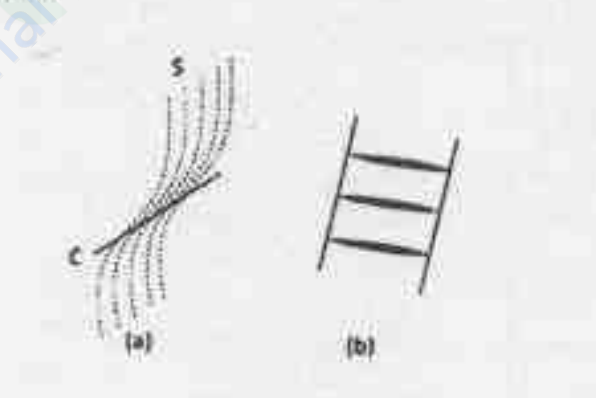
Figures (a) and (b) show S-C structure and en-echelon veins in two different shear zones. Which one of the following options is correct interpretation of sense of shear in figures (a) and (b)?