
Strike-Slip Fault Characteristics
Strike-slip faults are tectonic features where the Earth's crust moves horizontally relative to each other. Several landforms are characteristic indicators of their presence and activity.
Features Associated with Strike-Slip Faults
- Offset Drainage: The horizontal movement along a strike-slip fault can displace streams and rivers, causing their channels to appear 'offset' or bent where they cross the fault trace. This is a common and direct indicator.
- Shutter Ridge: When a strike-slip fault displaces a stream valley, the fault scarp can act as a barrier, blocking the valley and forming a ridge that 'shuts off' the original drainage path. This is a distinctive feature.
- Sag Pond: These are small depressions that form in fault zones, often due to the complex deformation and subsidence associated with strike-slip faulting, or where blocked drainage creates a pool. They are frequently found along active strike-slip faults.
Feature Not Typically Associated: Barbed Drainage
Barbed drainage refers to a pattern where tributaries flow into a main river channel and then turn sharply upstream (forming a 'barb' shape). This pattern is most commonly associated with:
- Glacial processes, where ice flow can alter drainage patterns.
- Headward erosion and stream capture, where one river system erodes backward and intercepts the flow of another.
While complex interactions can occur in any landscape, barbed drainage is not a primary or typical geomorphological indicator directly caused by the horizontal displacement characteristic of strike-slip faults, unlike offset drainage or shutter ridges.
Therefore, Barbed drainage is the feature not typically associated with strike-slip faults.
Important Questions from Joints And Faults
- Which one of the following predicts the correct tectonic settings for development of the positive flower structure and the negative flower structure?
- Which one of the following statements is correct?
- Shortening in the Earth's crust is typically accommodated by
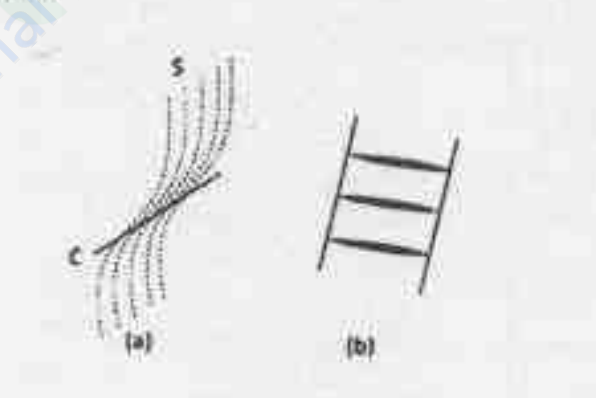
Figures (a) and (b) show S-C structure and en-echelon veins in two different shear zones. Which one of the following options is correct interpretation of sense of shear in figures (a) and (b)?
Each of the following two figures shows a pair of overlapping strike-slip faults with sense of movement.
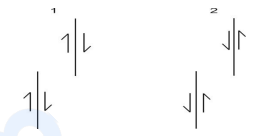
Predict the nature of structures in the overlapping zones of each pair of faults.


