
Question
Figures (a) and (b) show S-C structure and en-echelon veins in two different shear zones. Which one of the following options is correct interpretation of sense of shear in figures (a) and (b)? 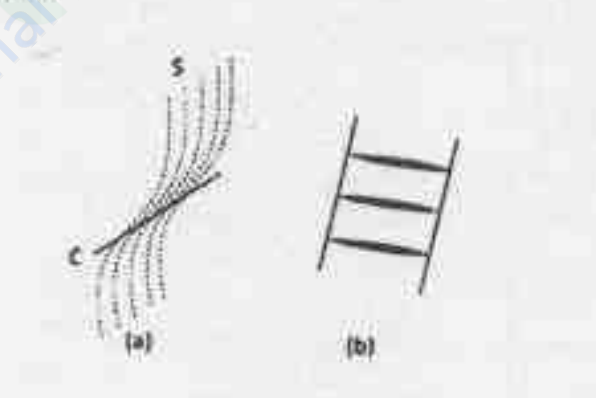
The correct answer is
(a) dextral; (b) dextral
To determine the sense of shear in Figures (a) and (b), we need to understand the characteristics of S-C structures and en-echelon veins.
- S-C Structure Analysis in Figure (a):
- The S-plane is the schistosity or foliation plane, which forms due to deformation.
- The C-plane, or shear plane, represents the direction of maximum shear.
- The orientation of these planes helps in identifying the sense of shear. When the C-plane is inclined relative to the S-plane, it indicates shear sense.
- In dextral (right-lateral) shear, the C-plane is oriented such that viewing from above, the sense of movement is clockwise.
- In the given figure, the C-plane aligns with a dextral shear, indicating right-lateral motion.
- En-Echelon Veins Analysis in Figure (b):
- En-echelon veins are series of tension fractures developed due to shear stress.
- The orientation and pattern help identify the shear sense.
- In dextral shear, en-echelon veins typically form at an angle and show a clockwise rotation.
- Figure (b) displays a pattern consistent with dextral shear, confirming right-lateral motion.
Thus, both figures exhibit dextral shear characteristics. This leads us to conclude the correct option is:
(a) dextral; (b) dextral
Was this answer helpful?
Important Questions from Joints And Faults
- Which one of the following predicts the correct tectonic settings for development of the positive flower structure and the negative flower structure?
- Which one of the following is not typically associated with strike-slip faults?
- Which one of the following statements is correct?
- Shortening in the Earth's crust is typically accommodated by
Each of the following two figures shows a pair of overlapping strike-slip faults with sense of movement.
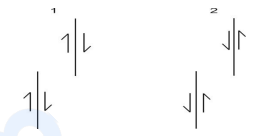
Predict the nature of structures in the overlapping zones of each pair of faults.
Need Expert Advice?


