
Shortening Accommodation in Earth's Crust
Crustal shortening occurs when the Earth's crust is compressed, reducing its horizontal extent. This process is typically accommodated by specific types of geological structures.
Understanding Fault Types and Crustal Deformation
Different types of faults are associated with different tectonic forces:
- Normal Faults: These accommodate extension (lengthening) of the crust. The hanging wall moves down relative to the footwall.
- Pull-apart basins: These form in areas of strike-slip faulting where there is local extension.
- Horst and Graben Structures: These are formed by normal faults during crustal extension, creating uplifted blocks (horsts) and down-dropped blocks (grabens).
- Thrust Faults: These are faults where the hanging wall moves up and over the footwall, accommodating significant shortening and thickening of the crust. They are characteristic features of compressional tectonic settings, such as convergent plate boundaries.
Conclusion on Shortening Mechanisms
Based on the definitions, thrust faults are the primary structures that accommodate shortening in the Earth's crust.
Important Questions from Joints And Faults
- Which one of the following predicts the correct tectonic settings for development of the positive flower structure and the negative flower structure?
- Which one of the following is not typically associated with strike-slip faults?
- Which one of the following statements is correct?
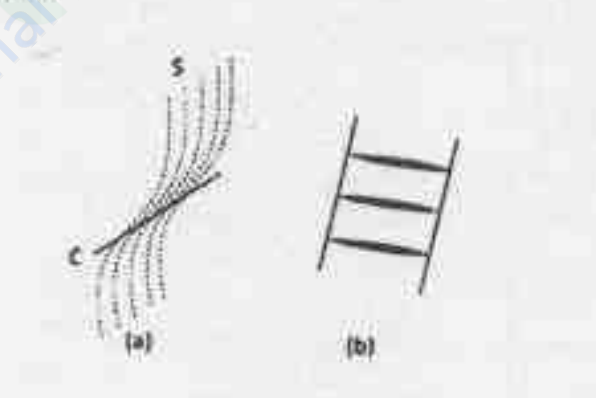
Figures (a) and (b) show S-C structure and en-echelon veins in two different shear zones. Which one of the following options is correct interpretation of sense of shear in figures (a) and (b)?
Each of the following two figures shows a pair of overlapping strike-slip faults with sense of movement.
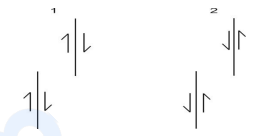
Predict the nature of structures in the overlapping zones of each pair of faults.


