Each of the following two figures shows a pair of overlapping strike-slip faults with sense of movement.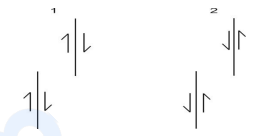
Predict the nature of structures in the overlapping zones of each pair of faults.
The question involves predicting the nature of structures formed in the overlapping zones of strike-slip faults based on the given figures. A strike-slip fault is a type of fault where the movement is horizontal, parallel to the fault line.
The figures show two pairs of overlapping strike-slip faults with arrows indicating the direction of movement. We need to predict whether these zones will form a graben or ridge structure:
- For the first figure:
- Consider the direction of movement. In areas where strike-slip faults overlap and move apart, they tend to create extensional zones.
- These extensional zones often lead to the formation of a graben, which is a block of the Earth's crust that has dropped down relative to surrounding blocks.
- For the second figure:
- If the movement of overlapping faults is towards each other, it creates compressional zones.
- These compressional zones develop into a ridge, where a block of the Earth's crust is pushed upward relative to the surrounding blocks.
Based on the movement indicated by the faults:
- The overlapping zone in the first figure forms a Graben.
- The overlapping zone in the second figure forms a Ridge.
Thus, the correct answer is:
(1) Graben (2) Ridge
Important Questions from Joints And Faults
- Which one of the following predicts the correct tectonic settings for development of the positive flower structure and the negative flower structure?
- Which one of the following is not typically associated with strike-slip faults?
- Which one of the following statements is correct?
- Shortening in the Earth's crust is typically accommodated by
Figures (a) and (b) show S-C structure and en-echelon veins in two different shear zones. Which one of the following options is correct interpretation of sense of shear in figures (a) and (b)?