Understanding Bedding Traces in Geological Cross-Sections
A geological cross-section represents a vertical slice through the Earth's subsurface. The way rock layers (beds) appear in this cross-section depends on how the layers are oriented relative to the cutting plane. Key terms here are uniformly dipping beds, strike, and the orientation of the cross-section.
Defining Strike and Dip
- Strike is the compass direction of the line formed where a rock layer intersects a horizontal plane.
- Dip is the angle the rock layer makes with the horizontal, measured downwards in a vertical plane perpendicular to the strike.
Cross-Section Along the Strike Line
The question describes a cross-section drawn "through strike line". In geology, this typically refers to a cross-section plane oriented parallel to the strike direction. This is often called a "strike section".
Reasoning for Bedding Trace Appearance
- We have uniformly dipping beds, meaning they have a constant dip.
- The strike line is a horizontal line on the bedding plane.
- The cross-section plane is oriented parallel to this strike line.
- Therefore, the intersection of the dipping beds with this strike-parallel vertical plane appears as horizontal lines.
In contrast, a cross-section perpendicular to the strike (a "dip section") would show bedding traces inclined at the true dip angle.
Similar Questions
- Extension joints develop perpendicular to the
- Strike direction and dip angle are measured in
Important Questions from Joints And Faults
- Which one of the following predicts the correct tectonic settings for development of the positive flower structure and the negative flower structure?
- Which one of the following is not typically associated with strike-slip faults?
- Which one of the following statements is correct?
- Shortening in the Earth's crust is typically accommodated by
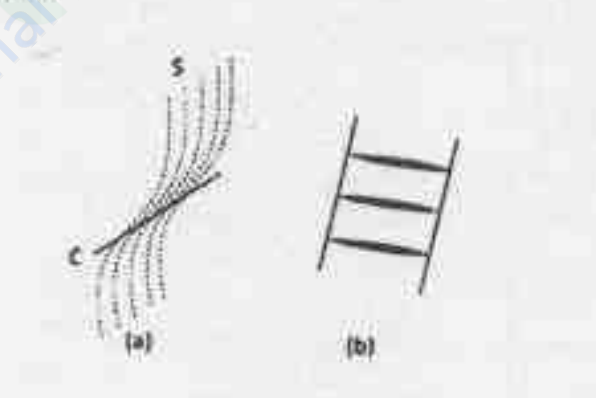
Figures (a) and (b) show S-C structure and en-echelon veins in two different shear zones. Which one of the following options is correct interpretation of sense of shear in figures (a) and (b)?