Directions: The following table shows the number of candidates trained by five institutes and the training fee charged per candidate during a particular session. Study the table carefully and answer the questions that follow.
Institute Candidates Trained Fee per Candidate (₹) A 240 18,000 B 300 16,000 C 180 24,000 D 360 15,000 E 220 20,000
| Institute | Candidates Trained | Fee per Candidate (₹) |
| A | 240 | 18,000 |
| B | 300 | 16,000 |
| C | 180 | 24,000 |
| D | 360 | 15,000 |
| E | 220 | 20,000 |
₹ 54,00,000
Institute D originally trains 360 candidates at ₹ 15,000 each. Both figures change, so recompute each one before multiplying.
Candidates fall by 20%: \(360 \times 0.80 = 288\).
Fee rises by 25%: \(15{,}000 \times 1.25 = 18{,}750\).
The new collection is \(288 \times 18{,}750 = 54{,}00{,}000\).
The result is worth a second look: a 20% fall paired with a 25% rise means the collection is multiplied by \(0.80 \times 1.25 = 1\), so the fee collected is exactly what it was before the changes.
Hence, the fee collected by Institute D is ₹ 54,00,000.
₹ 2,44,40,000
Institute B's fee rises by 25%, so its new fee per candidate is \(16{,}000 \times 1.25 = 20{,}000\), while its 300 candidates stay unchanged. Every other institute is untouched.
Now multiply candidates by fee for each institute:
A: \(240 \times 18{,}000 = 43{,}20{,}000\); B: \(300 \times 20{,}000 = 60{,}00{,}000\); C: \(180 \times 24{,}000 = 43{,}20{,}000\).
D: \(360 \times 15{,}000 = 54{,}00{,}000\); E: \(220 \times 20{,}000 = 44{,}00{,}000\).
Adding the five figures gives \(43{,}20{,}000 + 60{,}00{,}000 + 43{,}20{,}000 + 54{,}00{,}000 + 44{,}00{,}000 = 2{,}44{,}40{,}000\).
Hence, the new total fee collected is ₹ 2,44,40,000.
₹ 4,920·45
Split the institutes by size first. Those training 250 or fewer are A (240), C (180) and E (220); those training more than 250 are B (300) and D (360).
For the first group the total fee is \(43{,}20{,}000 + 43{,}20{,}000 + 44{,}00{,}000 = 1{,}30{,}40{,}000\) over \(240 + 180 + 220 = 640\) candidates, so the weighted average is \(\frac{1{,}30{,}40{,}000}{640} = 20{,}375\).
For the second group the total fee is \(48{,}00{,}000 + 54{,}00{,}000 = 1{,}02{,}00{,}000\) over \(300 + 360 = 660\) candidates, so the weighted average is \(\frac{1{,}02{,}00{,}000}{660} = \frac{1{,}70{,}000}{11} \approx 15{,}454.55\).
The excess is \(20{,}375 - \frac{1{,}70{,}000}{11} = \frac{2{,}24{,}125 - 1{,}70{,}000}{11} = \frac{54{,}125}{11} \approx 4{,}920.45\).
Hence, the weighted average fee exceeds the other by ₹ 4,920·45.
₹ 2,32,40,000
The total collection is the sum of candidates multiplied by fee for each of the five institutes.
A: \(240 \times 18{,}000 = 43{,}20{,}000\); B: \(300 \times 16{,}000 = 48{,}00{,}000\); C: \(180 \times 24{,}000 = 43{,}20{,}000\).
D: \(360 \times 15{,}000 = 54{,}00{,}000\); E: \(220 \times 20{,}000 = 44{,}00{,}000\).
Adding them gives \(43{,}20{,}000 + 48{,}00{,}000 + 43{,}20{,}000 + 54{,}00{,}000 + 44{,}00{,}000 = 2{,}32{,}40{,}000\).
Hence, the total fee collected by all five institutes is ₹ 2,32,40,000.
216 : 245
Compute each institute's collection as candidates multiplied by fee, then group them as the question asks.
Institutes A and C together collect \(240 \times 18{,}000 + 180 \times 24{,}000 = 43{,}20{,}000 + 43{,}20{,}000 = 86{,}40{,}000\).
Institutes D and E together collect \(360 \times 15{,}000 + 220 \times 20{,}000 = 54{,}00{,}000 + 44{,}00{,}000 = 98{,}00{,}000\).
The ratio is \(86{,}40{,}000 : 98{,}00{,}000 = 864 : 980\), and dividing both terms by 4 gives \(216 : 245\), which has no further common factor.
Hence, the ratio is 216 : 245.
Similar Questions
Directions: The following pie chart represents the amount spent on different sports by a school in a calendar year. If the amount spent on football is ₹ 9,000, answer the following questions :
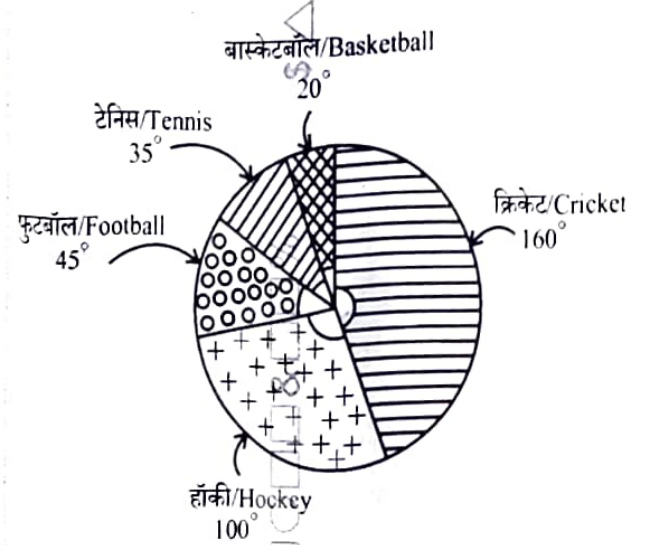
If the total amount spent on Football increases from ₹ 9,000 to ₹ 18,000 (and the pie chart remains unchanged), the combined amount spent on Hockey and Basketball is :
What is the amount spent on Basketball ?
What fraction of the total amount is spent on Cricket ?
How much more is spent on Hockey than on Football ?
Important Questions from Data Interpretation
The table shows the monthly expenditure of Saumya. What percent of her monthly salary is she able to save?
Expense Amount Food 5,000 Rent 20,000 Travel 10,000 Clothing 3,000 Miscellaneous 15,000 Savings 7,500 Who had the best score on either test?
Who had the most consistent scores on both tests?
Who had the least consistent scores on both tests?
Who had the poorest score on either test?