A. Microwave
B. Radio wave
C. Visible light
D. X-ray
E. Gamma rays
Choose the correct answer from the options given below :
Electromagnetic Radiation Frequency Order
The question asks to arrange specific types of electromagnetic radiation based on their frequency, in increasing order.
Electromagnetic Spectrum Basics
The electromagnetic (EM) spectrum categorizes EM radiation by frequency ($f$) and wavelength ($\lambda$). These are inversely proportional, related by the speed of light ($c = \lambda f$). Higher frequency means shorter wavelength.
The general order of increasing frequency (and decreasing wavelength) is:
- Radio waves
- Microwaves
- Infrared radiation
- Visible light
- Ultraviolet radiation
- X-rays
- Gamma rays
Identifying the Radiation Types
The specific types mentioned in the question are:
- A. Microwave
- B. Radio wave
- C. Visible light
- D. X-ray
- E. Gamma rays
Determining the Correct Sequence
Arranging the given types in order of increasing frequency:
- Radio wave (B): Lowest frequency among the given options.
- Microwave (A): Higher frequency than radio waves.
- Visible light (C): Higher frequency than microwaves.
- X-ray (D): Higher frequency than visible light.
- Gamma rays (E): Highest frequency among the given options.
Therefore, the correct sequence of increasing frequency is B, A, C, D, E.
Matching the Options
The sequence B, A, C, D, E corresponds to the option listing Radio wave, Microwave, Visible light, X-ray, Gamma rays in increasing frequency order.
This matches Option 2.
Similar Questions
- Calculate the output voltage of an op-amp for input voltages of $V_{i1} = 150 \mu\text{V}$ and $V_{i2} = 140 \mu\text{V}$. The amplifier has a differential gain of $A_d = 4000$ and the value of CMRR is $100$ :
- For an op-amp having a slew rate of $4\text{ V}/\mu\text{s}$, what is the maximum closed-loop voltage gain that can be used when input signal varies by $0.1\text{V}$ in $10\mu\text{s}$ ?
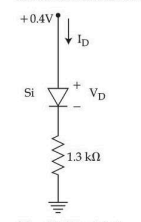
For the series diode configuration of the given figure, determine $V_D$ and $I_D$.
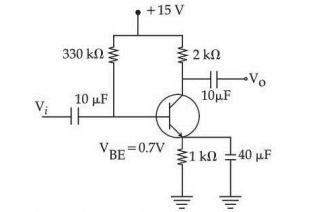
For the given emitter-bias network, determine the values of $I_C$ and $V_{CE}$. Assume $\beta = 100$.
- Given below are two statements : one is labelled as Assertion (A) and the other is labelled as Reason (R).
Assertion (A) : The gate of a MOSFET is insulated from body of FET by deposition of a very thin fragile layer of $\text{SiO}_2$ over the substrate.
Reason (R) : The device is therefore called an insulated gate field-effect transistor (IGFET).
In the light of the above statements, choose the most appropriate answer from the options given below : - Given below are two statements : one is labelled as Assertion (A) and the other is labelled as Reason (R).
Assertion (A) : The body effect in MOSFET causes the threshold voltage $V_{\text{th}}$ to increase as source-body voltage $V_{\text{SB}}$ increases.
Reason (R) : Increasing $V_{\text{SB}}$ raises the surface potential and therefore reduces the barrier for inversion.
In the light of the above statements, choose the most appropriate answer from the options given below : - Sequence for standard n-well fabrication process is :
A. Passivation
B. n-well implant
C. Metallization
D. Source/drain diffusion
Choose the correct answer from the options given below : - What is the typical efficiency of half-wave rectifier:
- The sequence of physical events when forward bias is applied to PN junction:
A. Barrier potential reduces
B. Majority carriers injected across junction
C. Recombination in neutral regions increases
D. Diffusion current established across quasi-neutral regions
E. Net forward current increases
Choose the correct answer from the options given below : - In an op-amp which of the following parameters depend on frequency.
A. Voltage gain
B. Noise current
C. CMRR
D. Output voltage swing
E. Gain bandwidth product
Choose the correct answer from the options given below :
Important Questions from Miscellaneous
- Which of the following relationships is/are not true?
(A). Most probable velocity = $\sqrt{\frac{2RT}{M}}$
(B). PV = $\frac{3}{2}kT$
(C). Compressibility factor Z = $\frac{pV}{nRT}$
(D). Average kinetic energy of gas = $\frac{1}{2}kT$
Choose the correct answer from the options given below - Match List-I with List-II
List-I List-II Electronic Configuration First Ionisation energy (kJ mol$^{-1}$) (A). ns$^2$ (I). 2100 (B). ns$^2$np$^1$ (II). 1400 (C). ns$^2$np$^3$ (III). 800 (D). ns$^2$np$^6$ (IV). 900
Choose the correct answer from the options given below: - The shielding constant of a 2p electron (calculated using Slater's rules) is
- Match List-I with List-II
List-I List-II Spectroscopy Property (A). Raman (I). Polarizability (B). FTIR (II). Dipole Moment (C). UV-Visible (III). Absorbance (D). NMR (IV). Spin
Choose the correct answer from the options given below: - The structure of protein comprises of:
(A). Primary structure of protein is associated with amino acids
(B). Secondary structure of protein is associated to peptides
(C). Tertiary structure of protein is associated with polypeptide chains
(D). Quaternary structure of protein is associated with polypeptide chains
Choose the correct answer from the options given below: