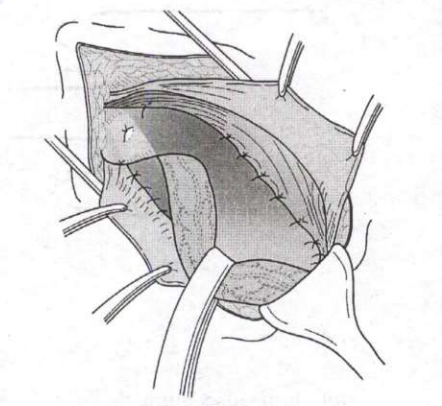
Consider the following statements regarding Ménétrier's disease: 1. There is excessive production of Transforming Growth Factor-alpha (TGF-alpha). 2. Majority of the patients present with features of protein-losing enteropathy. 3. Mucus secreting cells are replaced by parietal and chief cells. 4. The mucosal folds of the body and fundus of the stomach are greatly enlarged. Which of the statements given above are correct?
1, 2 and 4
Ménétrier's disease is characterized by TGF-alpha overexpression driving foveolar hyperplasia (statement 1 correct), massive gastric protein loss causing hypoalbuminemia and protein-losing enteropathy (statement 2 correct), and giant, greatly enlarged rugal folds in the body and fundus (statement 4 correct). However, the pathology is the opposite of statement 3 — parietal and chief cells are replaced/atrophied and substituted by mucus-secreting foveolar cells, not the reverse. Hence statements 1, 2 and 4 are correct.
Similar Questions
A 30-year-old female with irritable bowel syndrome presents with predominant symptom of diarrhea. Which of the following will be helpful in her treatment?
1. Loperamide
2. Lactulose
3. Lubiprostone
4. Sorbitol
Select the correct answer using the code given below:
'Melanosis coli' (brownish discoloration of colonic mucosa) can occur due to the long-term consumption of which one of the following?
The '13C-urea breath test' and the 'faecal antigen test' are non-invasive techniques to diagnose infection with which one of the following?
Patients suffering from which of the following condition(s) can get symptomatic relief by consuming a gluten-free diet?
1. Coeliac disease
2. Peptic ulcer disease
3. Dermatitis herpetiformis
Select the correct answer using the code given below:
Consider the following statements regarding 'Barrett's Oesophagus':
1. It is a pre-malignant condition.
2. The normal columnar mucosa of lower oesophagus is replaced by squamous cells.
3. It is an adaptive response to chronic gastro-oesophageal reflux.
Which of the statements given above is/are correct?
The presence of which of the following is suggestive of metastatic spread of an underlying gastrointestinal malignancy?
1. Krukenberg Tumour
2. Virchow's Node
3. Meigs' Syndrome
4. Sister Mary Joseph's Nodule
Select the correct answer using the code given below:
Important Questions from Peptic Ulcer Disease
- Modified Blatchford score is used for the risk stratification of:
- Presence of gastrinoma tumor should be suspected in which of the following conditions?
1. Ulcers in unusual location
2. Ulcers in the presence of H. pylori
3. Ulcers with frank complication like perforation
Select the correct answer using the code given below: - Which one of the following statements about Barrett's Oesophagus is NOT correct?
- Eradication of helicobacter pylori infection may prove beneficial in the following extra-gastric disorders EXCEPT:
Risk scoring system used to stratify the patients of acute upper gastrointestinal bleeding to predict the need for intervention to treat bleeding is: