A simple harmonic oscillator consists of a mass attached to a spring. The mass moves back and forth due to the restoring force exerted by the spring. The parameters given for this system are the mass \(m\) kg and the spring constant \(k\) Nm-1.
The equation for a simple harmonic oscillator is given by:
\(F = -kx = ma\)
The acceleration \(a\) can be linked to velocity \(v\) and position \(x\) using the energy conservation principle:
\(\frac{1}{2}mv^2 + \frac{1}{2}kx^2 = \text{constant}\)
The equation above signifies that the sum of kinetic and potential energy remains constant, representing an ellipse in the \(x-v\) phase space.
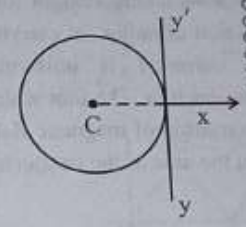
For the graph of \(v\) as a function of \(x\) to be a circle, the equation should be of the form where the coefficient of \(x^2\) and \(v^2\) are equal. Thus:
\(\frac{1}{2}mv^2 + \frac{1}{2}kx^2 = E \quad \Rightarrow \quad mv^2 = kx^2\)
For the coefficients of \(v^2\) and \(x^2\) to be equal, we require:
\(m = k\)
Therefore, for the graph to be a circle, the relationship \(k = m\) must hold true.
Hence, the correct option is:
$k=m$
Similar Questions
For a travelling harmonic wave $y(x, t) = 2.0 \cos 2\pi(10 t - 0.0080 x + 0.35)$, where $x$ and $y$ are in cm and $t$ in s. The phase difference between oscillatory motion of two points separated by a distance of $0.5 \text{ m}$ is :
- For a simple pendulum, having time period T, the variation of kinetic energy (K.E.) with time (t) is represented by :
- The sum of kinetic energy and potential energy of a simple pendulum bob is $0.02 \text{ joule}$. The speed of the simple pendulum bob at equilibrium position is approximately :
(Consider mass of the bob = $20 \text{ g}$) - For sound waves, if the number of nodes for the $5^{\text{th}}$ harmonic of an open-ended pipe is $n$ and that for the $9^{\text{th}}$ harmonic of the same pipe with one of its ends closed is $m$, the ratio $\frac{n}{m}$ is :
- A cylindrical cork of uniform density floats in a liquid of density $\rho_1$. If the cork is depressed slightly and released, it oscillates harmonically with time period T. If the same cork floats in another liquid of density $\rho_2$, then the similar oscillation has time period 2T. The value of $\rho_2/\rho_1$ is :
Important Questions from Oscillations and Waves
- Two tuning forks $A$ and $B$ are sounded together giving rise to $8$ beats in $2\text{ s}$. When fork $A$ is loaded with wax, the beat frequency is reduced to $4$ beats in $2\text{ s}$. If the original frequency of tuning fork $B$ is $380\text{ Hz}$ then original frequency of tuning fork $A$ is _________ $\text{Hz}$.
- A simple pendulum of string length 30 cm performs 20 oscillations in 10 s. The length of the string required for the pendulum to perform 40 oscillations in the same time duration is ___________ cm. [Assume that the mass of the pendulum remains same.]
- The velocity of sound in air is doubled when the temperature is raised from $0^\circ\text{C}$ to $\alpha^\circ\text{C}$. The value of $\alpha$ is ________.
- The equation of a transverse wave is $y = y_0 \sin 2\pi(ft - \frac{x}{\lambda})$. If the maximum particle velocity be four times that of wave velocity then
- The velocity of a particle executing simple harmonic motion along $x$-axis is described as $v^2 = 50 - x^2$, where $x$ represents displacement. If the time period of motion is $\frac{x}{7}~\text{s}$, the value of $x$ is ________.