Under which scenario is a body on an inclined plane most likely to slip when subjected to a parallel force?
Coefficient of friction is less than tangent of inclination
Consider a body of weight mg resting on a plane inclined at angle θ, with the applied force acting parallel to the surface. Resolving the weight into components along and perpendicular to the incline:
- Component tending to slide the body down the slope = mg·sin θ.
- Normal reaction, N = mg·cos θ.
- Maximum available (limiting) friction that resists motion = μN = μ·mg·cos θ, where μ is the coefficient of friction.
The body is on the point of slipping when the driving component just exceeds the friction the surface can supply:
mg·sin θ > μ·mg·cos θ ⇒ dividing both sides by mg·cos θ ⇒ tan θ > μ, i.e. μ < tan θ.
This is exactly the condition "coefficient of friction is less than the tangent of the inclination", so that option is correct. The special case μ = tan θ defines the angle of repose, at which the body is on the verge of sliding; below that (μ < tan θ) friction can no longer hold it and it slips.
The other statements do not describe the slip condition:
- Frictional force equals the weight of the body is not a meaningful slipping criterion; slipping depends on comparing the down-slope component with limiting friction, not on friction equalling the full weight.
- Normal reaction greater than weight cannot occur for a plain incline (N = mg·cos θ ≤ mg), and a larger N would actually raise the available friction, making slipping less likely, not more.
- Parallel force opposite to the frictional force merely describes a direction; on its own it says nothing about whether the driving effort exceeds limiting friction, which is what determines slipping.
Hence the body is most likely to slip when μ < tan θ.
Similar Questions
Which type of friction occurs when surfaces are lubricated with a fluid?
If a block slides down a rough plane inclined at 30° with a coefficient of friction of 0.2, the net acceleration is:
Which of the following is not a type of friction?
With an increase in angle of the inclined surface, the maximum angle at which a body starts sliding down the plane is called ___________.
A block of weight (W) rests on a rough inclined plane with an angle of inclination α shown in the figure. The coefficient of friction between the block surface and the plane is μ, R is the normal reaction perpendicular to the inclined plane. A force (P) is applied parallel to the plane to prevent the block from sliding down. Which of the following represents the minimum value of (P) required to maintain equilibrium?
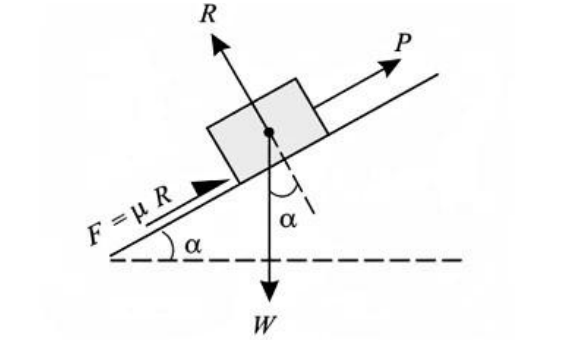
A body is resting on a rough inclined plane. If the frictional force is equal to the component of weight along the plane, the body is in:
Important Questions from Friction
A steel wheel of 600 mm diameter rolls on a horizontal steel rail. It carries a load of 500 N. The coefficient of rolling resistance is 0.3 mm. The force in N, necessary to roll the wheel along the rail is:
Which of the following option is CORRECT about the methods used to reduce the friction?
Which of the following is NOT a law of static friction?
If we push the break of car then car will begin to slide when:
An elephant is stopped by a rope wound twice around the rough trunk of a tree. If the elephant exerts a pull of 1000 kgf, the minimum force required to stop the elephant is_________. (Coefficient of friction between the rope and the tree is 0.3)