Which type of friction occurs when surfaces are lubricated with a fluid?
Film friction
Friction is classified according to the physical mechanism resisting relative motion between two bodies. When two surfaces are separated by a continuous lubricant layer, the classification is film friction (also called fluid friction), which is the correct answer.
In film (fluid) friction the mating surfaces are completely separated by a film of lubricant, so there is no direct metal-to-metal contact of the asperities. The resistance to motion no longer comes from surface roughness but instead from the viscosity (internal shearing) of the fluid — adjacent layers of the lubricant slide over one another and the shear stress developed is proportional to the velocity gradient and the fluid's viscosity. This is the ideal lubrication regime (hydrodynamic/thick-film lubrication) sought in journal bearings, because it gives very low friction and virtually no wear of the solid surfaces.
The other options describe different friction mechanisms and do not involve a separating fluid film:
- Dry friction (Coulomb friction) occurs between un-lubricated solids in direct contact, arising from interlocking and adhesion of surface asperities — the exact opposite of a lubricated condition.
- Rolling friction is the resistance encountered when one body rolls over another (as a wheel or ball bearing does); it is governed by elastic deformation at the contact, not by a lubricant film.
- Static friction is the friction that must be overcome to start motion between surfaces at rest; it describes a state of motion (impending motion), not the presence of a fluid.
Therefore, when the surfaces are lubricated with a fluid, the friction present is film friction.
Similar Questions
Under which scenario is a body on an inclined plane most likely to slip when subjected to a parallel force?
If a block slides down a rough plane inclined at 30° with a coefficient of friction of 0.2, the net acceleration is:
Which of the following is not a type of friction?
With an increase in angle of the inclined surface, the maximum angle at which a body starts sliding down the plane is called ___________.
A block of weight (W) rests on a rough inclined plane with an angle of inclination α shown in the figure. The coefficient of friction between the block surface and the plane is μ, R is the normal reaction perpendicular to the inclined plane. A force (P) is applied parallel to the plane to prevent the block from sliding down. Which of the following represents the minimum value of (P) required to maintain equilibrium?
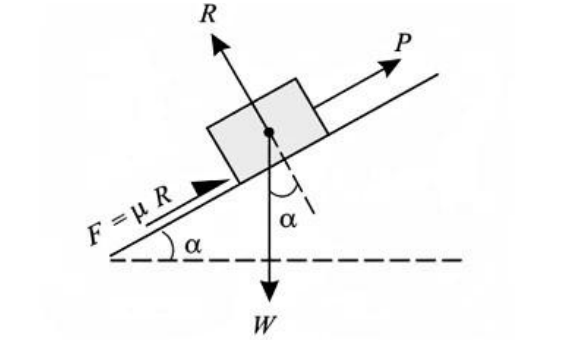
A body is resting on a rough inclined plane. If the frictional force is equal to the component of weight along the plane, the body is in:
Important Questions from Friction
A steel wheel of 600 mm diameter rolls on a horizontal steel rail. It carries a load of 500 N. The coefficient of rolling resistance is 0.3 mm. The force in N, necessary to roll the wheel along the rail is:
Which of the following option is CORRECT about the methods used to reduce the friction?
Which of the following is NOT a law of static friction?
If we push the break of car then car will begin to slide when:
An elephant is stopped by a rope wound twice around the rough trunk of a tree. If the elephant exerts a pull of 1000 kgf, the minimum force required to stop the elephant is_________. (Coefficient of friction between the rope and the tree is 0.3)