
Among 160 players in a tournament, 57 did not participate in any of the three games, i.e. Cricket, Hockey and Badminton. A total of 37 players participated in only one game, 10 players participated in both Cricket and Hockey but not in Badminton, 9 players participated in both Hockey and Badminton but not in Cricket, and 13 players participated in both Cricket and Badminton but not in Hockey. How many players participated in all the three games?
34
Tournament Player Participation Analysis
This problem requires us to determine the number of players involved in all three games (Cricket, Hockey, Badminton) within a tournament. We are given the total number of players, the count of those who sat out entirely, and details about participation in single games and specific overlaps between two games. We need to use this information to find the number of players participating in all three sports.
Key Tournament Participation Data
Here's a summary of the information provided:
- Total players in the tournament: 160
- Players not participating in any game (Cricket, Hockey, Badminton): 57
- Players participating in exactly one game: 37
- Players participating in Cricket and Hockey only: 10
- Players participating in Hockey and Badminton only: 9
- Players participating in Cricket and Badminton only: 13
Calculating Active Participants
First, let's find the number of players who participated in at least one game. This is the total number of players minus those who didn't participate in any game.
Number of players in at least one game = Total players - Players not in any game
Number of players in at least one game = $160 - 57 = 103$
So, $103$ players actively participated in the tournament across the three games.
Participation Categories Breakdown
The total number of active participants ($103$) can be broken down into three mutually exclusive groups:
- Those who played exactly one game.
- Those who played exactly two games.
- Those who played exactly three games.
We can write this relationship as:
Players in at least one game = (Players in exactly one game) + (Players in exactly two games) + (Players in exactly three games)
Calculating Players in Exactly Two Games
We need to sum the counts of players who participated in specific pairs of games but not the third:
- Cricket and Hockey only: 10
- Hockey and Badminton only: 9
- Cricket and Badminton only: 13
Total players in exactly two games = $10 + 9 + 13 = 32$
Determining Players in All Three Games
Let '$x$' be the number of players who participated in all three games (Cricket, Hockey, and Badminton).
Now we can plug the known values into our participation breakdown equation:
Players in at least one game = (Players in exactly one game) + (Players in exactly two games) + (Players in exactly three games)
$103 = 37 + 32 + x$
Combine the numbers for one and two games:
$103 = 69 + x$
To find '$x$', subtract 69 from 103:
$x = 103 - 69$
$x = 34$
Final Answer
Based on the calculations, the number of players who participated in all three games (Cricket, Hockey, and Badminton) is 34.
Similar Questions
In the Venn diagram shown here, the triangle represents ‘students’, the circle represents ‘diploma holders’ and the quadrilateral represents ‘graduates’. The numbers given in the diagram represents number of persons of that particularcategory.
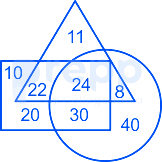
How many students are diploma holders but NOT graduates?
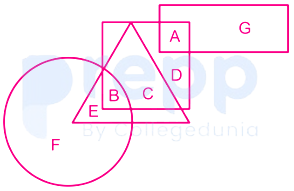
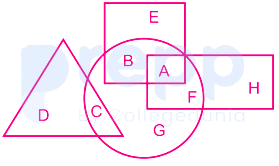
In the following figure, square represents Optometrists, triangle represents Painters, circle represents Vegetarians and rectangle represents Men. Which set of letters represents painters who are either men or vegetarians?
In the following figure, square represents athletes, triangle represents engineers, circle represents fathers and rectangle represents entrepreneurs. Which set of letters represents athletes who are either entrepreneurs or fathers?
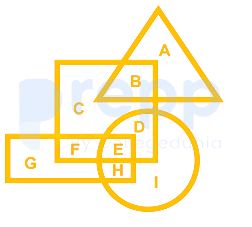
Which of the following Venn diagrams best represents the relationship between the classes?
Tables, Wooden objects, ChairsIn the given Venn diagram, the hexagon represents ‘farmers’, the circle represents ‘beneficiaries’ and the square represents ‘land-owners’. The numbers given in the diagram represent the number of persons in that particular category.
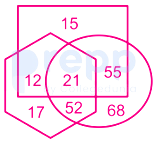
How many farmers are both land-owners and beneficiaries?
In the following figure, square represents Pharmacists, triangle represents singers, circle represents Surgeons and rectangle represents Mothers. Which set of letters represents Surgeons who are either mother or singers?
In the Venn diagram given below, the circle represents ‘Ladies’, the triangle represents ‘Constables’ and the square represents ‘Married persons’. The numbers given in the diagram represents number of persons of that particular category.
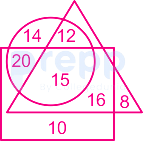
How many lady constables are NOT married?
In the given Venn diagram, the ‘ rectangle ’ represents ‘ ladies of a club’ , the ‘ triangle ’ represents ‘like to dance’ , the ‘ circle ’ represents ‘ like to sing’ and the ‘ pentagon ’ represents ‘ like to mimic’ . The numbers given in the diagram represents the number of persons in that particular category.
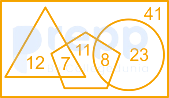
How many ladies of the club NEITHER like to dance NOR like to mimic?
In a class of 100 students, every student has passed in one or more of the three subjects, i.e History, Economics and English. Among all the student, 24 students have passed in English only, 14 students have passed in History only 11 students have passed in both English and Economics only, and 12 students have passed in both English and History only. A total of 50 students have passed in History. If only 5 students have passed in all three subjects, then how many students have passed in Economies only?
In the given Venn diagram, ‘Group A’ represents those who can speak ‘English’, ‘Group B’ represents those who can speak ‘Hindi’, and ‘Group C’ represents those who can speak ‘Marathi’. The numbers given in the diagram represent the number of persons in that particular category.
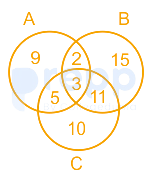
How many persons can speak exactly two languages?
Important Questions from Venn Diagram Problems
In a group of 73 friends, 14 friends go to Gym and Karate classes both, whereas 7 friends neither go to Gym class nor to Karate class. If a total of 36 friends go to Gym class, then how many friends go to only Karate class?
In an examination 20% students failed in Mathematics and 15% failed in English. If 10% failed in both and those who passed in both numbered 300, then the total number of students who appeared in the examination was
In the following diagram, the 'circle' stands for 'soldiers', the 'square' stands for 'Indians', and the 'triangle' stands for 'singers'. The numbers given in the different segments represent persons belonging to that category.
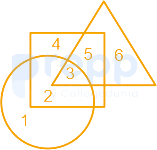
Which category is represented by the number '5'?
- In the following diagram, the circle stands for 'policemen', the square stands for 'sportspersons' and the 'triangle' stands for 'tax-payers' the numbers given in the different segments represent the number of persons in that category.
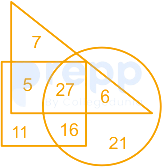
How many policemen are tax-payers but are NOT sportspersons?
Which of the following Venn diagrams represents the relationship between Lions, Deers and Carnivores?



