($\epsilon_0$ is the permittivity of vacuum)
[Image of sphere and tube]
Charged Sphere Potential Calculation
For a uniformly charged sphere with radius $R$ and charge density $\rho$, the electric field outside the sphere ($r \ge R$) behaves like a point charge at the center. The total charge is $Q = \rho \times \frac{4}{3}\pi R^3$. The electric field is:
$ E_{out}(r) = \frac{1}{4\pi\epsilon_0} \frac{Q}{r^2} = \frac{\rho R^3}{3\epsilon_0 r^2} $
The electric potential outside the sphere ($V_{out}(r)$), taking the potential at infinity $V(\infty) = 0$, is obtained by integrating the electric field:
$ V_{out}(r) = \int_{\infty}^{r} E_{out}(r') dr' = \int_{\infty}^{r} \frac{\rho R^3}{3\epsilon_0 r'^2} dr' = \frac{\rho R^3}{3\epsilon_0} \left[ -\frac{1}{r'} \right]_{\infty}^{r} = \frac{\rho R^3}{3\epsilon_0 r} $
Potential at Initial and Final Points
The initial position of the unit positive charge is A at $r_A = 2R$, and the final position is B at $r_B = 3R$. Both points are located outside the sphere ($r > R$).
The potential at point A ($V_A$):
$ V_A = V_{out}(2R) = \frac{\rho R^3}{3\epsilon_0 (2R)} = \frac{\rho R^2}{6\epsilon_0} $
The potential at point B ($V_B$):
$ V_B = V_{out}(3R) = \frac{\rho R^3}{3\epsilon_0 (3R)} = \frac{\rho R^2}{9\epsilon_0} $
Work Done Calculation
The work done ($W$) on a unit positive charge ($q=1$) when moved from point A to point B is equal to the change in potential energy, which is $W = q(V_B - V_A)$.
$ W = 1 \times (V_B - V_A) = \frac{\rho R^2}{9\epsilon_0} - \frac{\rho R^2}{6\epsilon_0} $
Combine the terms:
$ W = \frac{\rho R^2}{\epsilon_0} \left( \frac{1}{9} - \frac{1}{6} \right) = \frac{\rho R^2}{\epsilon_0} \left( \frac{2 - 3}{18} \right) = -\frac{\rho R^2}{18\epsilon_0} $
Determine Value of n
The problem states that the magnitude of the total work done is $\frac{\rho R^2}{n\epsilon_0}$.
The magnitude of the calculated work ($|W|$) is:
$ |W| = \left| -\frac{\rho R^2}{18\epsilon_0} \right| = \frac{\rho R^2}{18\epsilon_0} $
Equating the calculated magnitude to the given expression:
$ \frac{\rho R^2}{18\epsilon_0} = \frac{\rho R^2}{n\epsilon_0} $
By comparing the two expressions, we find the value of $n$:
$ n = 18 $
Similar Questions
- Consider two uncharged capacitors of equal capacitance $200 \text{ pF}$. One of them is charged by a $100 \text{ V}$ supply and disconnected. Now this capacitor is connected to the uncharged capacitor. The amount of electrostatic energy lost in the process is :
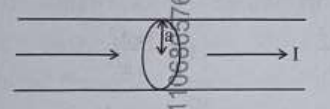
The figure given below shows a long straight solid wire of circular cross-section of radius 'a' carrying steady current I. The current I is uniformly distributed across its cross-section. The plot which correctly represents the variation of magnetic field (B) with distance (r) from the axis of the conductor in the region is :
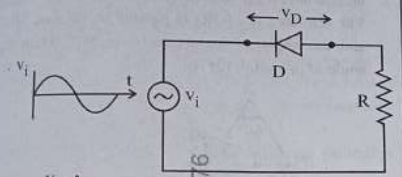
In the circuit shown below, the voltage appearing across the diode D will be of the form :
A 100-turn closely wound circular coil of radius $10 \text{ cm}$ has a magnetic field of $3.14 \times 10^{-3} \text{ T}$ at its centre. The current passing through the coil, and the magnitude of the magnetic moment of this coil are, respectively :
(Take $\mu_0 = 4\pi \times 10^{-7} \text{ T m/A}$)The current $I$ in the circuit shown below is :
(All diodes are ideal and identical.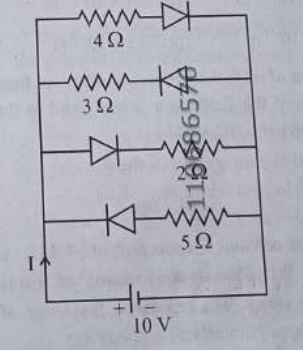
- A galvanometer of resistance $100 \ \Omega$ gives full scale deflection for a current of $1 \text{ mA}$. It is converted into an ammeter of range $0 - 10 \text{ A}$. The shunt required is :
- An ac circuit contains a resistance of $1 \text{ k}\Omega$, a capacitor of $0.1 \ \mu\text{F}$ and an inductor of $1 \text{ mH}$ connected in series. The resonance frequency of the circuit is approximately :
- Two statements are given below :
A. When the forward bias voltage across a p-n junction diode increases above a certain threshold voltage, the diode current increases significantly.
B. This current is called reverse saturation current.
Choose the correct answer from the options given below : - A rectangular wire loop of sides $8 \text{ cm}$ and $3 \text{ cm}$ with a small cut, is moving out of a region of uniform magnetic field of magnitude $0.3 \text{ T}$ directed normal to the plane of the loop. The emf developed across the cut, if the velocity of the loop is $2 \text{ cm s}^{-1}$ in a direction normal to the shorter side of the loop, will be :
- A resistor is connected to a battery of $12 \text{ V}$ emf and internal resistance $2 \ \Omega$. If the current in the circuit is $0.6 \text{ A}$, the terminal voltage of the battery is :
Important Questions from Electricity and Magnetism
- A short bar magnet placed with its axis at $30^\circ$ with an external field of 800 Gauss, experiences a torque of 0.016 N.m. The work done in moving it from most stable to most unstable position is $\alpha \times 10^{-3} \text{ J}$. The value of $\alpha$ is ______.
- An electromagnetic wave of frequency $100\text{ MHz}$ propagates through a medium of conductivity, $\sigma = 10\text{ mho/m}$. The ratio of maximum conduction current density to maximum displacement current density is __________.
$\left[ \text{Take } \frac{1}{4\pi\varepsilon_0} = 9 \times 10^9\text{ Nm}^2\text{/C}^2 \right]$ - An inductor stores $16\text{ J}$ of magnetic field energy and dissipates $32\text{ W}$ of thermal energy due to its resistance when an a.c. current of $2\text{ A}$ (rms) and frequency $50\text{ Hz}$ flows through it. The ratio of inductive reactance to its resistance is _________. ($\pi = 3.14$)
- A simple pendulum made of mass 10 g and a metallic wire of length 10 cm is suspended vertically in a uniform magnetic field of 2 T. The magnetic field direction is perpendicular to the plane of oscillations of the pendulum. If the pendulum is released from an angle of $60^\circ$ with vertical, then maximum induced EMF between the point of suspension and point of oscillation is ___________ mV. (Take $g = 10\text{ m/s}^2$)
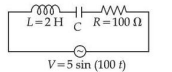
Using a variable frequency a.c. voltage source the maximum current measured in the given LCR circuit is 50 mA for $V = 5\sin(100t)$ The values of L and R are shown in the figure. The capacitance of the capacitor (C) used is ___________ $\mu\text{F}$.