
A statement is given followed by two conclusions. Find which conclusion is TRUE based on the given statement. Statement: $P \ge T; Q = R \ge U; V \ge R < S; T \ge Q$ Conclusions: I: $T \ge U$ II: $V > T$
Inequality Logic Reasoning
This problem requires analyzing a set of relationships (statement) to determine the validity of two potential conclusions.
Analyzing the Statement
The given relationships are:
- $P \ge T$
- $Q = R \ge U$
- $V \ge R < S$
- $T \ge Q$
Evaluating Conclusion I: $T \ge U$
We need to see if $T$ is greater than or equal to $U$. Let's combine the relevant parts of the statement:
- We know $T \ge Q$.
- We know $Q = R$.
- Substituting $R$ for $Q$, we get $T \ge R$.
- We also know $R \ge U$.
- Combining $T \ge R$ and $R \ge U$ gives us the chain $T \ge R \ge U$.
- This directly implies $T \ge U$.
Therefore, Conclusion I is TRUE.
Evaluating Conclusion II: $V > T$
We need to see if $V$ is strictly greater than $T$. Let's combine the relevant parts:
- We know $V \ge R$.
- From the previous analysis, we established $T \ge R$ (derived from $T \ge Q$ and $Q = R$).
- We have two relationships involving $R$: $V \ge R$ and $T \ge R$.
- These inequalities tell us that both $V$ and $T$ are greater than or equal to $R$. However, they do not provide a direct comparison between $V$ and $T$. $V$ could be equal to $T$, less than $T$, or greater than $T$, while still satisfying $V \ge R$ and $T \ge R$.
For example, if $R=5$, $T=6$, and $V=6$, then $V \ge R$ and $T \ge R$ are true, but $V > T$ is false. If $R=5$, $T=6$, and $V=7$, then $V > T$ is true. Since it's not always true, we cannot conclude $V > T$.
Therefore, Conclusion II is FALSE (or undetermined).
Final Result
Only Conclusion I logically follows from the given statement.
Similar Questions
In this question, some equations are solved on the basis of a certain system. On the same basis, find out the correct answer from amongst the four alternatives for the unsolved equation:
462 = 551
398 = 487
856 = ?Find the missing number in the series:
8 6 7 9 13 11 3 7 ? In this question, some equations are solved on the basis of a certain system. On the same basis find out the correct answer from amongst the four alternatives for the unsolved equation.
7x6x8=678
8x9x7=987
6x5x7=567
5x4x6=?Select the missing number from the given alternatives:
7 9 8 8 9 ? 4 9 6 60 90 70 Select the missing number from the given matrix:
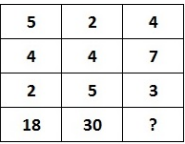
Select the missing numbers from the given alternatives:
? 120 150 110 100 90 80 60 40 If 3 *4 = 10, 5 *8 = 18, 7 *7 =?
In the following question, a series is given with one term missing. Choose the correct alternative from the given ones that will complete the series.
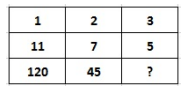
If - means ÷, + means ×, ÷ means -, × means +, then which of the following equations is correct?
Find the missing number from the given response.
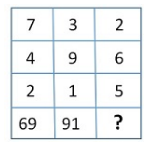
Important Questions from Mathematical Inequalities
Directions: In the following question assuming the given statements to be true, find which of the conclusion(s) among given conclusions is/are definitely true and then give your answers accordingly.
Statement:
Y ≥ C < O ≥ F < R = B
Conclusions:
I. B > F
II. R > C
Directions: In each of the following questions assuming the given statement to be true, find which of the conclusions among given conclusions is / are definitely true and then give your answers accordingly.
Statement: E < U > L > K ≤ T = H ≤ Q
Conclusions:
I. U > H
II. T ≤ Q
Directions: In the following question assuming the given statements to be True, find which of the conclusion among given conclusions is/are definitely true and then give your answers accordingly.
Statements: Y > U ≥ Z ≥ K = X ≤ B ≤ A
Conclusions:
I. U = X
II. U > X
Directions: In each of the following questions assuming the given statement to be true, find which of the conclusions among given conclusions is/are definitely true and then give your answers accordingly.
Statement: S > L < P = T ≥ V > R
Conclusions:
I. P > R
II. S > V
In the question given, relations between different elements are shown in the statements. These statements are followed by two conclusions. Find out which of the given conclusions follow(s) the given statements and select the correct alternative from the given choices.
Statement:
L ≥ M = N < O, P < Q ≥ R = S ≥ L
Conclusion:
I. Q > M
II. N = Q



