
A statement is given followed by two conclusions. Find which conclusion is TRUE based on the given statement. Statement: Conclusions:
C ≥ T ; A = D ≥ O ; G ≥ D < S ; T ≥ A
I: A ≤ O
II: C ≥ G
Neither I nor II
Given: C ≥ T ≥ A = D ≥ O and G ≥ D < S
Conclusion I: A ≤ O
Since A = D ≥ O, we get A ≥ O. So A ≤ O is FALSE.
Conclusion II: C ≥ G
From the chain: C ≥ T ≥ A = D and G ≥ D. We cannot establish a definite relationship between C and G (G could be greater, equal, or less than C). So II is NOT DEFINITE.
Hence, Neither I nor II follows.
Similar Questions
Select the missing numbers from the given responses.
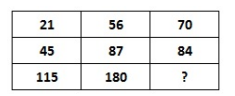
If 37*14 = 17, 69*33 = 34, 91*125 = 72, then what should 28*56 = ?
In this question, some equations are solved on the basis of a certain system. On the same basis, find out the correct answer from amongst the four alternatives for the unsolved equation:
462 = 551
398 = 487
856 = ?Find the missing number in the series:
8 6 7 9 13 11 3 7 ? In this question, some equations are solved on the basis of a certain system. On the same basis find out the correct answer from amongst the four alternatives for the unsolved equation.
7x6x8=678
8x9x7=987
6x5x7=567
5x4x6=?Select the missing number from the given alternatives:
7 9 8 8 9 ? 4 9 6 60 90 70 Select the missing number from the given matrix:
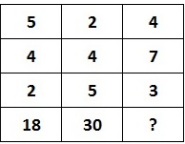
If 3 *4 = 10, 5 *8 = 18, 7 *7 =?
In the following question, a series is given with one term missing. Choose the correct alternative from the given ones that will complete the series.
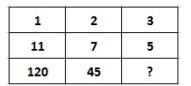
If - means ÷, + means ×, ÷ means -, × means +, then which of the following equations is correct?
Important Questions from Mathematical Inequalities
In this question, relationship between different elements is shown in the statement. This statement is followed by two conclusions:
Statements:
$C<H\le A =M > P > I ≥O> N$
Conclusions:
i) $A > P$
ii) $P > N$
Choose the appropriate one from the following options
(A) Only conclusion i follows
(B) Only conclusion ii follows
(C) Either i or ii follows
(D) Neither i nor ii follows
(E) Both i and ii follow.In this question, relationship between different elements is shown in the statement. This statement is followed by two conclusions:
Statement:
C > H ≥ I = P < O ≤ T < L < E
Conclusions:
i) H < T
ii) E ≥ PChoose the appropriate one from the following options
(A) Only conclusion i follows
(B) Only conclusion ii follows
(C) Either i or ii follows
(D) Neither i nor ii follows
(E) Both i and ii followIn this question, relationship between different elements is shown in the statement. This statement is followed by two conclusions:
Statement:
S < A ≤ N < D = W > I ≥ C > H
Conclusions:
i) S < N
ii) D ≥ A
Choose the appropriate one from the following options
(A) Only conclusion i follows
(B) Only conclusion ii follows
(C) Either i or ii follows
(D) Neither i nor ii follows
(E) Both i and ii followIn this question, relationship between different elements is shown in the statement. This statement is followed by two conclusions:
Statements:
F<U≤N=C<T=I>O≥R
Conclusions:
i) F<C
ii) U<T
Choose the appropriate one from the following options
(A) Only conclusion i follows
(B) Only conclusion ii follows
(C) Either i or ii follows
(D) Neither i nor ii follows
(E) Both i and ii follow.In this question, relationship between different elements is shown in the statement. This statement is followed by two conclusions:
Statement:
$T>H>O\geq U=S<A< N\leq D$
Conclusions:
i) $H > A$
ii) $N > O$
Choose the appropriate one from the following options
(A) Only conclusion i follows
(B) Only conclusion ii follows
(C) Either i or ii follows
(D) Neither i nor ii follows
(E) Both i and ii follow



