Geography Optional Paper 1 Question Paper 2025 with Detailed Solution; Download PDF
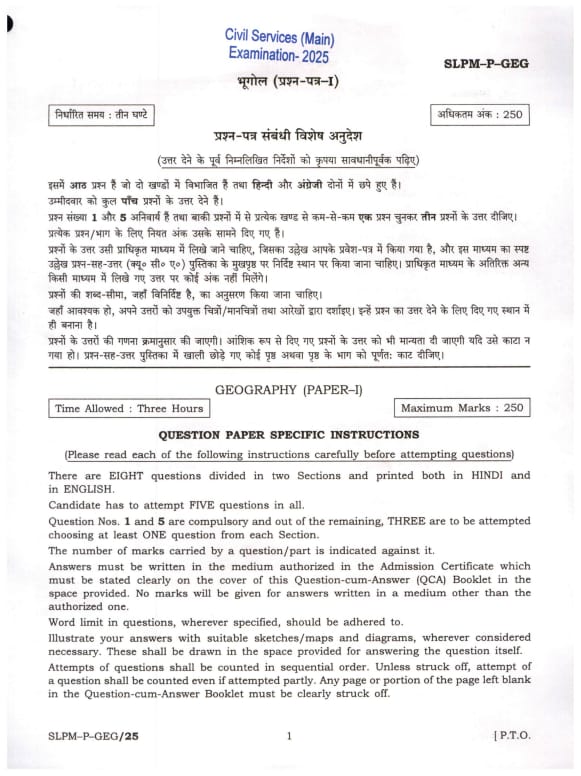
UPSC Mains 2025 Question Paper for Geography Optional Paper-I is available here to download in PDF Format. The exam has been conducted on August 31, 2025, in Forenoon Session (09:00 AM to 12 Noon). Check UPSC IAS 2025 Question Papers. This Paper comprises 8 questions which are of 250 marks. The duration of the exam is 3 hours.
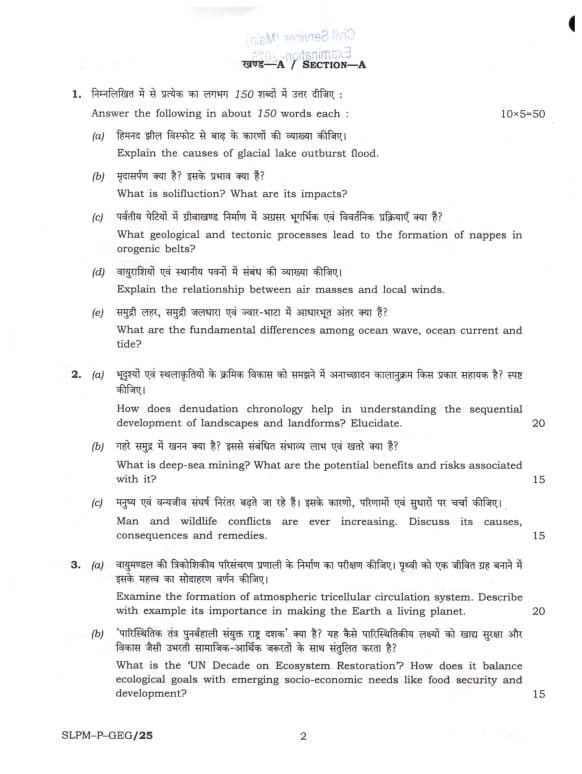
SECTION-A / खण्ड-A
1. Answer the following in about 150 words each:
निम्नलिखित में से प्रत्येक का लगभग 150 शब्दों में उत्तर दीजिए: (Marks 10×5=50)
(a) Explain the causes of glacial lake outburst flood.
हिमनद झील विस्फोट से बाढ़ के कारणों की व्याख्या कीजिए।
(b) What is solifluction? What are its impacts?
मृदासर्पण क्या है? इसके प्रभाव क्या है?
(c) What geological and tectonic processes lead to the formation of nappes in orogenic belts?
पर्वतीय पेटियों में ग्रीबाखण्ड निर्माण में अग्रसर भूगर्भिक एवं विवर्तनिक प्रक्रियाएँ क्या है?
(d) Explain the relationship between air masses and local winds.
बायुराशियों एवं स्थानीय पवनों में संबंध की व्याख्या कीजिए।
(e) What are the fundamental differences among ocean wave, ocean current and tide?
समुद्री लहर, समुद्री जलधारा एवं ज्वार-भाटा में आधारभूत अंतर क्या है?
2.(a) How does denudation chronology help in understanding the sequential development of landscapes and landforms? Elucidate..
भूदुश्यों एवं स्थलाकृतियों के क्रमिक विकास को समझने में अनाच्छादन कालानुक्रम किस प्रकार सहायक है? स्पष्ट कीजिए। (20 Marks)
(b) What is deep-sea mining? What are the potential benefits and risks associated with it?
गहरे समुद्र में खनन क्या है? इससे संबंधित संभाव्य लाभ एवं खतरे क्या है? (15 Marks)
(c) Man and wildlife conflicts are ever increasing. Discuss its causes, consequences and remedies.
मनुष्य एवं वन्यजीव संघर्ष निरंतर बढ़ते जा रहे हैं। इसके कारणों, परिणामों एवं सुधारों पर चर्चा कीजिए। (15 Marks)
3.(a) Examine the formation of atmospheric tricellular circulation system. Describe with example its importance in making the Earth a living planet.
वायुमण्डल की त्रिकोशिकीय परिसंचरण प्रणाली के निर्माण का परीक्षण कीजिए। पृथ्वी को एक जीवित ग्रह बनाने में इसके महत्त्व का सोदाहरण वर्णन कीजिए। (Marks 20)
(b) What is the 'UN Decade on Ecosystem Restoration? How does it balance ecological goals with emerging socio-economic needs like food security and development?
'पारिस्थितिक तंत्र पुनर्बहाली संयुक्त राष्ट्र दशक' क्या है? यह कैसे पारिस्थितिकीय लक्ष्यों को खाद्य सुरक्षा और विकास जैसी उभरती सामाजिक-आर्थिक जरूरतों के साथ संतुलित करता है? (Marks 15)
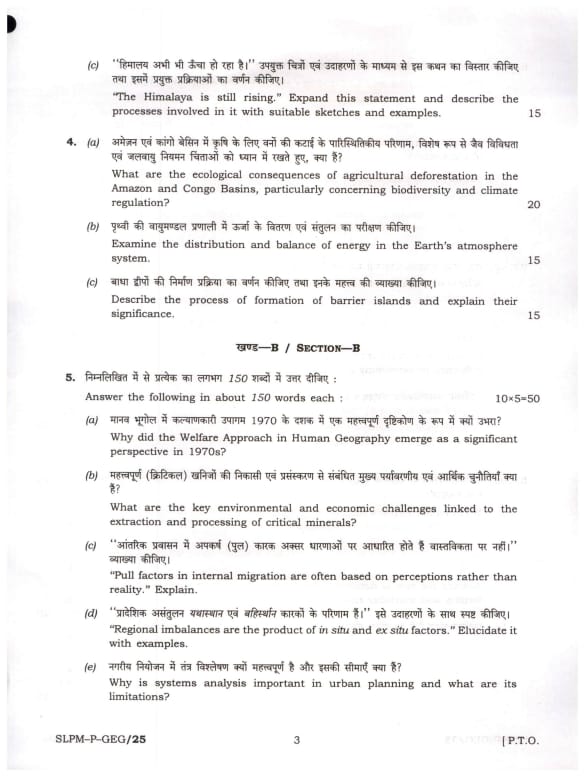
(c) "The Himalaya is still rising." Expand this statement and describe the processes involved in it with suitable sketches and examples.
"हिमालय अभी भी ऊँचा हो रहा है।" उपयुक्त चित्रों एवं उदाहरणों के माध्यम से इस कथन का विस्तार कीजिए तथा इसमें प्रयुक्त प्रक्रियाओं का वर्णन कीजिए। (Marks 15)
4.(a) What are the ecological consequences of agricultural deforestation in the Amazon and Congo Basins, particularly concerning biodiversity and climate regulation?
अमेजन एवं कांगो बेसिन में कृषि के लिए वनों की कटाई के पारिस्थितिकीय परिणाम, विशेष रूप से जैव विविधता एवं जलवायु नियमन चिंताओं को ध्यान में रखते हुए, क्या है? (Marks 20)
(b) Examine the distribution and balance of energy in the Earth's atmosphere system.
पृथ्वी की वायुमण्डल प्रणाली में ऊर्जा के वितरण एवं संतुलन का परीक्षण कीजिए। (Marks 15)
(c) Describe the process of formation of barrier islands and explain their significance.
बाधा द्वीपों की निर्माण प्रक्रिया का वर्णन कीजिए तथा इनके महत्व की व्याख्या कीजिए। (Marks 15)
SECTION-B / खण्ड-B
5. Answer the following in about 150 words each:
निम्नलिखित में से प्रत्येक का लगभग 150 शब्दों में उत्तर दीजिए: (Marks 10×5=50)
(a) Why did the Welfare Approach in Human Geography emerge as a significant perspective in 1970s?
मानव भूगोल में कल्याणकारी उपागम 1970 के दशक में एक महत्त्वपूर्ण दृष्टिकोण के रूप में क्यों उभरा?
(b) What are the key environmental and economic challenges linked to the extraction and processing of critical minerals?
महत्त्वपूर्ण (क्रिटिकल) खनिजों की निकासी एवं प्रसंस्करण से संबंधित मुख्य पर्यावरणीय एवं आर्थिक चुनौतियाँ क्या ?
(c) "Pull factors in internal migration are often based on perceptions rather than reality." Explain.
"आंतरिक प्रवासन में अपकर्ष (पुल) कारक अक्सर धारणाओं पर आधारित होते हैं बास्तविकता पर नहीं।" व्याख्या कीजिए।
(d) "Regional imbalances are the product of in situ and ex situ factors." Elucidate it with examples.
"प्रादेशिक असंतुलन यथास्थान एवं बहिस्र्थान कारकों के परिणाम हैं।" इसे उदाहरणों के साथ स्पष्ट कीजिए।
(e) Why is systems analysis important in urban planning and what are its limitations?
नगरीय नियोजन में तंत्र विश्लेषण क्यों महत्त्वपूर्ण है और इसकी सीमाएँ क्या है?
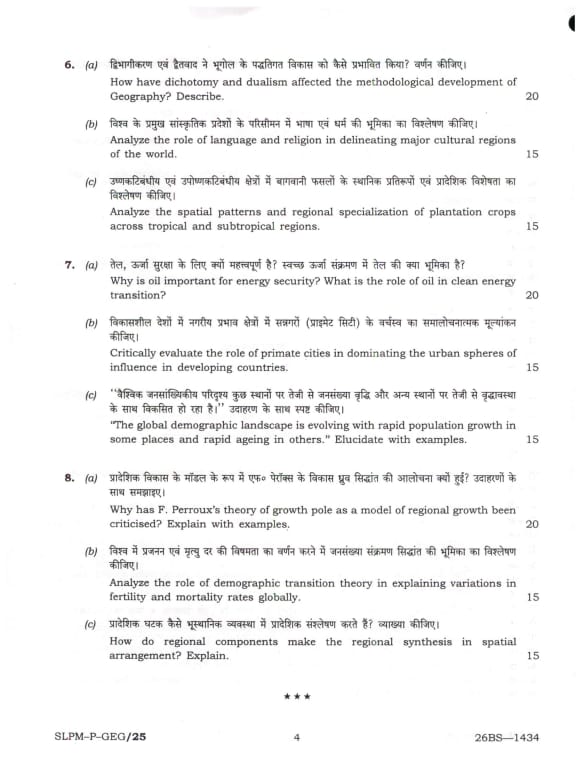
6.(a) How have dichotomy and dualism affected the methodological development of Geography? Describe.
द्विभागीकरण एवं द्वैतवाद ने भूगोल के पद्धतिगत विकास को कैसे प्रभावित किया? वर्णन कीजिए। (Marks 20)
(b) Analyze the role of language and religion in delineating major cultural regions of the world.
विश्व के प्रमुख सांस्कृतिक प्रदेशों के परिसीमन में भाषा एवं धर्म की भूमिका का विश्लेषण कीजिए। (Marks 15)
(c) Analyze the spatial patterns and regional specialization of plantation crops across tropical and subtropical regions.
उष्णकटिचंधीय एवं उपोष्णकटिबंधीय क्षेत्रों में बागवानी फसलों के स्थानिक प्रतिरूपों एवं प्रादेशिक विशेषता का विश्लेषण कीजिए। (Marks 15)
7.(a) Why is oil important for energy security? What is the role of oil in clean energy transition?
तेल, ऊर्जा सुरक्षा के लिए क्यों महत्त्वपूर्ण है? स्वच्छ ऊर्जा संक्रमण में तेल की क्या भूमिका है? (Marks 20)
(b) Critically evaluate the role of primate cities in dominating the urban spheres of influence in developing countries.
विकासशील देशों में नगरीय प्रभाव क्षेत्रों में सनगरों (प्राइमेट सिटी) के वर्चस्व का समालोचनात्मक मूल्यांकन कीजिए। (Marks 15)
(c) "The global demographic landscape is evolving with rapid population growth in some places and rapid ageing in others." Elucidate with examples.
"वैश्विक जनसांख्यिकीय परिदृश्य कुछ स्थानों पर तेजी से जनसंख्या वृद्धि और अन्य स्थानों पर तेजी से वृद्धावस्था के साथ विकसित हो रहा है।" उदाहरण के साथ स्पष्ट कीजिए। (Marks 15)
8.(a) Why has F. Perroux's theory of growth pole as a model of regional growth been criticised? Explain with examples.
प्रादेशिक विकास के मॉडल के रूप में एफ० पेरॉक्स के विकास ध्रुव सिद्धांत की आलोचना क्यों हुई? उदाहरणों के साथ समझाइए। (Marks 20)
(b) Analyze the role of demographic transition theory in explaining variations in fertility and mortality rates globally.
विश्व में प्रजनन एवं मृत्यु दर की विषमता का वर्णन करने में जनसंख्या संक्रमण सिद्धांत की भूमिका का विश्लेषण कीजिए। (Marks 15)
(c) How do regional components make the regional synthesis in spatial arrangement? Explain.
प्रादेशिक घटक कैसे भूस्थानिक व्यवस्था में प्रादेशिक संश्लेषण करते हैं? व्याख्या कीजिए। (Marks 15)
UPSC Mains Geography Optional Paper 1 Question Paper 2025 with Detailed Solution; Download PDF (August 31, 2025)
UPSC Previous Year Question Papers
Other Relevant Articles
| UPSC IAS Exam Syllabus | UPSC IAS Exam Pattern | UPSC IAS Exam Current Affairs |
| UPSC IAS Exam Study Materials | UPSC IAS Mock Test Series | UPSC IAS Salary |
Check the latest Government Recruitment News here.
Join Prepp Telegram Channel today for further updates.
Download the PREPP App and attempt FREE IAS Exam Mock Tests and get complete study material!

Full Test - 04: UPSC CSE Prelims CSAT (Paper-II)
Full Test - 03: UPSC CSE Prelims CSAT (Paper-II)
UPSC CSE Prelims 2026 GS Paper 1 Question Paper (24-May-2026)
UPSC CSE Prelims 2026 CSAT Paper 2 Question Paper (24-May-2026)

17 February 2025 | The Hindu Must Read Articles | Current Affairs

16 February 2026 | The Hindu Must Read Articles | Current Affairs

13 February 2026 | The Hindu Must Read Articles | Current Affairs









Comments