
Read the following passage and answer the items that follow the passage. Your answers to these items should be based on the passage only. Passage-1 It is hard to predict how changes in the climate and the atmosphere’s chemistry will affect the prevalence and virulence of agricultural diseases. But there is a risk that such changes will make some plant infections more common in all climatic zones, perhaps catastrophically so. Part of the problem is that centuries of selective breeding have refined the genomes of most high-value crops. They are spectacular at growing in today’s conditions but genetic variations that are not immediately useful to them have been bred out. This is good for yields but bad for coping with changes. A minor disease or even an unknown one could suddenly rampage through a genetically honed crop.
With reference to the above passage, the following assumptions have been made:
I. Global climate change can result in the migration of several plant diseases to new areas.
II. Scientific understanding of the wild relatives of our present crops would enable us to strengthen food security.
Which of the above assumptions is/are valid?
Both I and II
Analyzing the Passage on Climate Change, Plant Diseases, and Crop Vulnerability
The passage discusses the potential impacts of changes in climate and atmospheric chemistry on agricultural diseases. It highlights the risk that these changes could make plant infections more common and virulent across different climatic zones. A key point is the vulnerability of modern crops, which have been genetically optimized for current conditions through selective breeding, often losing valuable genetic variations that are not immediately useful. This lack of genetic diversity makes these crops susceptible to being wiped out by a minor or new disease.
Evaluating Assumptions Based on the Passage
We need to assess the validity of the two given assumptions based *only* on the information provided in the passage.
Assumption I: Global climate change can result in the migration of several plant diseases to new areas.
The passage states that climate changes could make plant infections "more common in all climatic zones". While the word "migration" is not explicitly used, the phrase "more common in all climatic zones" suggests an expansion of the geographical range or distribution of diseases, implying they could appear in areas where they were less common or absent before. This aligns with the concept of diseases spreading or migrating to new areas due to changing environmental conditions. Therefore, this assumption is a reasonable inference drawn from the passage.
Assumption II: Scientific understanding of the wild relatives of our present crops would enable us to strengthen food security.
The passage emphasizes that modern crops, through selective breeding, have "bred out" genetic variations that are not immediately useful. This loss of genetic diversity makes them highly vulnerable to new or changing diseases ("A minor disease or even an unknown one could suddenly rampage through a genetically honed crop"). Wild relatives of cultivated crops are known reservoirs of genetic diversity, including traits like disease resistance that may have been lost in commercial varieties. Understanding and utilizing the genetics of these wild relatives could reintroduce valuable variations into crops, making them more resilient to diseases and thus strengthening food security. Although the passage doesn't explicitly mention "wild relatives," it directly links the lack of genetic variation in modern crops to their vulnerability and the potential catastrophic impact of diseases. The ability to strengthen crops against diseases by incorporating genetic diversity (which exists in wild relatives) is strongly implied as a solution to the vulnerability described. Therefore, this assumption is also a valid inference based on the passage's discussion of genetic variation, crop vulnerability, and the impact on agricultural diseases.
Conclusion on Assumption Validity
Based on the analysis of the passage:
- Assumption I is supported by the passage's mention of diseases becoming "more common in all climatic zones," implying a potential spread or migration.
- Assumption II is supported by the passage's discussion of the vulnerability caused by the loss of genetic variation in modern crops, implying the need for genetic diversity (often found in wild relatives) to enhance resilience and food security.
Therefore, both assumptions are valid based on the information provided in the passage.
Revision Table: Key Points from the Passage
| Topic | Passage Point |
|---|---|
| Climate Change & Diseases | Likely to affect prevalence and virulence; may make diseases more common in all climatic zones. |
| Modern Crops | Highly refined genomes from selective breeding; good for current yields but lack genetic variation. |
| Vulnerability | Loss of genetic variation makes crops susceptible to rampage by minor or unknown diseases. |
| Prediction Difficulty | Hard to predict exact effects of climate/atmosphere changes on diseases. |
Additional Information: Genetic Diversity and Food Security
Genetic diversity within crops is crucial for maintaining food security, especially in the face of environmental changes like climate change and the evolution of new diseases. Selective breeding for traits like high yield, uniform size, and pest resistance under specific conditions can inadvertently reduce the overall genetic variability in cultivated varieties. This genetic uniformity increases the risk of widespread crop failure if a new pest or disease emerges that the uniform population has no resistance against.
Wild relatives of crops often possess a wider range of genetic traits, including resistance to various stresses (diseases, pests, drought, salinity). By studying and utilizing the genetic resources found in these wild relatives, plant breeders can introduce beneficial genes back into cultivated crops. This process helps create new varieties that are more resilient and adaptable to changing conditions, thereby contributing significantly to global food security by reducing vulnerability to outbreaks and environmental shifts.
Similar Questions
Which one of the following statements best reflects the most logical and rational message conveyed by the author of the passage?
With reference to the above passage, the following assumptions have been made:
I. There is no need for the State to be involved in any manner in the handloom sector.
II. Handloom products are no longer appealing and attractive in the rapidly changing modern world.
Which of the above assumptions is/are valid?Which one of the following statements best reflects the central idea conveyed by the passage?
Which one of the following statements best reflects the central idea conveyed by the passage?
Which one of the following statements best reflects the critical message conveyed by the author of the passage?
With reference to the above passage, the following assumptions have been made:
I. Path-dependent green investments will eventually most likely benefit growth as well as public finances in a country like India.
II. If other green technologies follow the same pattern as that of solar energy, there will most likely be an easy green transition.
Which of the above assumptions is/are valid?A natural number N is such that it can be expressed as N = p + q + r, where p, q and r are distinct factors of N. How many numbers below 50 have this property?
Team X scored a total of N runs in 20 overs. Team Y tied the score in 10% less overs. Had Team Y’s average run rate (runs per over) been 50% higher, the scores would have been tied in 12 overs. How many runs were scored by Team X?
Consider the following statements:
I. If A ≤ B > C < D > E > F ≥ G = H; then B is always greater than E.
II. If P > Q = R ≥ S = T ≤ U = V > W; then S is always less than V.
Which of the statements given above is/are correct?Consider the first 100 natural numbers. How many of them are not divisible by any one of 2, 3, 5, 7 and 9?
Important Questions from Miscellaneous Topics
- In communication the word 'Haptics' signifies :
- Which of the following statements best defines the scope of semiotics?
The compound interest on Rs. 75,000 for three years, at successive interest rates of 4%, 6% and 9% for each year respectively is:
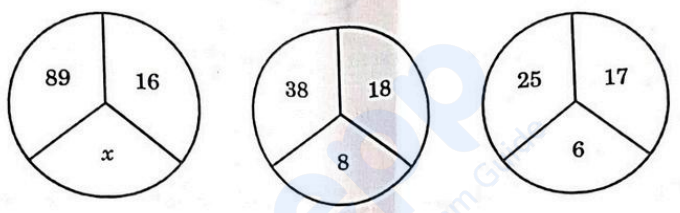
The value of x in the following figures is :
When a child reaches adolescence, there is apt to be a conflict between the parents and the child, since
the latter considers himself to be by now quite capable of managing his own affairs, while the former
are filled with parental solicitude, which is often a disguise for love of power. Parents consider, usually,
that the various moral problems which arise in adolescence are peculiarly their province. The options
they express, however, are so dogmatic that the young seldom confide in them, and usually go their
own way in secret.



