
Which one of the following statements regarding Ohm's law is not correct?
All homogeneous materials obey Ohm's law irrespective of whether the field is within range or strong.
Understanding Ohm's Law
Ohm's law is a fundamental principle in electrical circuits. It describes the relationship between the voltage across a conductor and the current flowing through it. For many materials, under specific conditions, the current through a conductor is directly proportional to the voltage applied across its ends, provided the temperature and other physical conditions remain constant. Mathematically, this is often expressed as:
\(V \propto I\)
Where \(V\) is the potential difference (voltage) and \(I\) is the current. This proportionality can be written as an equation:
\(V = IR\)
Here, \(R\) is the constant of proportionality, known as resistance. Materials or devices that obey this relationship are called ohmic materials or devices. However, it's important to note that Ohm's law is not a universal law of nature like Newton's laws or Maxwell's equations; it's an empirical relationship observed for a wide class of materials under certain conditions.
Analyzing the Statements on Ohm's Law
Let's examine each statement provided in the options to determine which one is not correct regarding Ohm's law.
Statement 1 Analysis: Current Proportionality
The statement says, "Ohm's law is an assumption that current through a conductor is always directly proportional to the potential difference applied to it." The core idea of Ohm's law is indeed this direct proportionality \(I \propto V\) under constant physical conditions. While calling it an "assumption" might be slightly nuanced (it's an empirical observation treated as a law within its domain), the direct proportionality is the fundamental tenet of Ohm's law for ohmic conductors. Therefore, this statement aligns with the definition of Ohm's law for materials that obey it.
Statement 2 Analysis: Resistance Independence from Voltage
The statement says, "A conducting device obeys Ohm's law when the resistance of a device is independent of magnitude and polarity of applied potential difference." If a device obeys Ohm's law (\(V=IR\)), then \(R\) must be constant for varying \(V\) and \(I\). This means the resistance \(R\) should not change based on how large the voltage is or whether the voltage is positive or negative (polarity). This independence of resistance from the magnitude and polarity of the applied voltage is a characteristic property of devices that obey Ohm's law. Thus, this statement is consistent with the definition of an ohmic device.
Statement 3 Analysis: Material Properties and Electric Field
The statement says, "A conducting material obeys Ohm's law when the resistance of material is independent of the magnitude and direction of applied electric field." Ohm's law can also be expressed microscopically in terms of current density \(J\) and electric field \(E\): \(J = \sigma E\), where \(\sigma\) is the conductivity of the material (and \(\sigma = 1/\rho\), where \(\rho\) is resistivity). For a material to obey Ohm's law, its conductivity (or resistivity) must be constant and independent of the magnitude and direction of the electric field applied within the material. If \(\sigma\) is constant, then the resistance \(R\) derived from the material's properties and geometry (\(R = \rho L/A\)) will also be independent of the applied field/voltage. This statement accurately reflects the condition for a material to be ohmic at a fundamental level.
Statement 4 Analysis: Homogeneous Materials and Field Strength
The statement says, "All homogeneous materials obey Ohm's law irrespective of whether the field is within range or strong." This statement makes a strong claim that all homogeneous materials obey Ohm's law and that this obedience holds irrespective of the field strength (weak or strong). This is not correct. While many homogeneous materials like metals obey Ohm's law under typical conditions (i.e., within a certain range of electric field or voltage), this is not universally true for all homogeneous materials. For example:
- Semiconductors (like silicon or germanium) are homogeneous but do not strictly obey Ohm's law across all voltage ranges, especially at higher voltages where the current-voltage relationship becomes non-linear.
- Electrolytes are homogeneous solutions but often exhibit non-ohmic behavior due to polarization effects.
- Even materials that are typically ohmic, like metals, can deviate from Ohm's law at very high electric field strengths or under extreme conditions (e.g., very low temperatures where superconductivity occurs).
Ohm's law is generally valid only for a limited range of electric field or voltage. When the field becomes very strong, the relationship between current and voltage often deviates from the linear proportionality \(V=IR\).
Why Statement 4 is Not Correct about Ohm's Law
Based on the analysis, Statement 4 is the one that is not correct regarding Ohm's law. It incorrectly claims that all homogeneous materials obey Ohm's law under all field strengths. Ohm's law has limitations and is only applicable to specific materials (ohmic materials) and typically within a certain range of applied voltage or electric field. Deviations occur, particularly at high field strengths, for many materials.
Revision Table: Key Aspects of Ohm's Law
| Aspect | Description |
|---|---|
| Basic Relationship | Current \(I\) is directly proportional to voltage \(V\) (\(V \propto I\)). |
| Equation | \(V = IR\), where \(R\) is resistance. |
| Condition for Obedience | Resistance \(R\) (or conductivity \(\sigma\)) must be constant, independent of \(V\), \(I\), \(E\), or \(J\), and physical conditions (like temperature) must be constant. |
| Ohmic Materials | Materials that obey Ohm's law (e.g., many metals under typical conditions). |
| Non-Ohmic Materials | Materials that do not obey Ohm's law (e.g., semiconductors, diodes, electrolytes, gases). Their \(V-I\) relationship is non-linear. |
| Limitations | Ohm's law is empirical and not universal. It typically holds only within a certain range of voltage/electric field and constant temperature. It may break down at very high fields or extreme temperatures. |
Additional Information: Limitations and Applications
Ohm's law is incredibly useful in analyzing and designing simple electrical circuits composed of resistors, voltage sources, and current sources operating under steady-state conditions within the ohmic range. However, its limitations are crucial for understanding more complex devices and materials.
- Non-Ohmic Devices: Components like diodes, transistors, and even light bulbs (filament temperature changes with current) do not have a constant resistance and therefore do not obey Ohm's law. Their current-voltage characteristics are non-linear.
- High Field Effects: At very high electric fields, charge carriers within a material can reach high velocities where their mobility might decrease, or other effects like impact ionization can occur, leading to deviations from the linear \(J = \sigma E\) relationship.
- Temperature Dependence: The resistance of most materials changes with temperature. Ohm's law \(V=IR\) is stated under the condition that physical conditions, including temperature, remain constant. If temperature changes significantly due to current flow (Joule heating), the material's resistance can change, causing a deviation from linearity unless the temperature effect is accounted for separately.
Understanding when and where Ohm's law is applicable, as well as its limitations, is key to mastering circuit analysis and material science.
Similar Questions
The graphs between current (I) and voltage (V) for three linear resistors 1, 2 and 3 are given below:
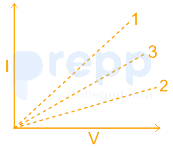
If R 1, R 2and R 3are the resistances of these resistors, then which one of the following is correct?
An electric circuit is given below. V1 = 1V and Resistance R=1000 Ω.
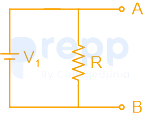
The current through the resistance R is very close to 1 mA and the voltage across point A and B, VAB = 1V. Now the circuit is changed to:
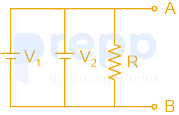
where value of V2 = 5V. The internal resistances of both the batteries are 0.1Ω . The current through the resistance R is about:
A simple circuit contains a 12 V battery and a bulb having 24-ohm resistance. When you turn on the switch, the ammeter connected to the circuit would read
Which one of the following devices is non-ohmic?
Important Questions from Ohm’s Law
Three resistors having resistances in the ratio 1 : 2 : 3 are in parallel. The current through the resistors are in the ratio
Which of the law states that in any closed circuit the current is directly proportional to the voltage, provided the physical conditions of the circuit are kept constant?
According to Ohm’s law, if current (I) increases and potential difference (V) remains constant, then:
Fill in the blank with the most appropriate option.
18 volts = _________ × 3 ohms.
- ______ states that the electric current flowing through a metallic wire is directly proportional to the potential difference ‘V’ across its ends provided its temperature remains the same.



