
Which one of the following devices is non-ohmic?
Semiconductor diode
Understanding Ohmic and Non-Ohmic Devices
In the study of electricity, devices are often classified based on their relationship between voltage and current. This relationship is described by Ohm's Law.
What is Ohm's Law?
Ohm's Law states that the voltage (\(V\)) across an ideal conductor is directly proportional to the current (\(I\)) flowing through it, provided all physical conditions (like temperature) remain constant. Mathematically, this is expressed as:
\(V = IR\)
Here, \(R\) is the resistance of the conductor, which is a constant value for a given material and temperature.
Ohmic Devices vs. Non-Ohmic Devices
Devices that obey Ohm's Law are called ohmic devices. Their current-voltage (I-V) characteristic graph is a straight line passing through the origin, indicating constant resistance.
Devices that do not obey Ohm's Law are called non-ohmic devices. Their I-V characteristic graph is not a straight line, meaning their resistance is not constant but varies with voltage or current.
Analyzing the Given Options
Let's examine each device listed in the options to determine if it is ohmic or non-ohmic.
- Conducting copper coil: Copper is a metal conductor. For most practical purposes and within reasonable temperature ranges, metallic conductors like copper obey Ohm's Law. Their resistance remains nearly constant. Thus, a conducting copper coil is generally considered an ohmic device.
- Electric heating coil: Heating coils are typically made of materials like nichrome, which are also metallic conductors. While their resistance does increase with temperature (and current flow causes heating), in many basic analyses, they are treated as obeying Ohm's Law over a limited range or at a constant temperature. However, compared to semiconductor devices, their deviation from Ohm's Law due to temperature is less pronounced in the context of typical ohmic/non-ohmic classifications where non-linearity is more significant.
- Semiconductor diode: A semiconductor diode is a p-n junction device. Its current-voltage characteristic is highly non-linear. It allows current to flow easily in one direction (forward bias) after a certain threshold voltage but blocks current flow almost completely in the opposite direction (reverse bias). The relationship between voltage and current is exponential in forward bias. This non-linear behaviour means its resistance is not constant but changes significantly with the applied voltage. Therefore, a semiconductor diode is a prime example of a non-ohmic device.
- Rheostat: A rheostat is a variable resistor. It is designed to provide a resistance that can be adjusted manually. However, for any *fixed* setting of the rheostat, the resistance value is constant. If you apply different voltages across the rheostat (at a fixed setting), the current will be proportional to the voltage, following Ohm's Law (\(V=IR\)) for that specific resistance value. Therefore, a rheostat, at a constant setting, behaves as an ohmic device.
Identifying the Non-Ohmic Device
Based on the analysis of each option's electrical characteristics:
- Conducting copper coil - Ohmic
- Electric heating coil - Primarily ohmic (with resistance varying with temperature)
- Semiconductor diode - Non-ohmic
- Rheostat - Ohmic (at a fixed resistance setting)
The device that most clearly exhibits a non-linear, non-ohmic behaviour among the choices is the semiconductor diode.
Revision Table: Ohmic vs. Non-Ohmic
| Feature | Ohmic Device | Non-Ohmic Device |
|---|---|---|
| Obeys Ohm's Law (\(V=IR\)) | Yes | No |
| Resistance (\(R\)) | Constant (at constant temperature) | Varies with voltage/current |
| I-V Characteristic Graph | Straight line through origin | Non-linear curve |
| Examples | Resistors, Ideal conductors | Semiconductor diode, Transistors, Thyristors |
Additional Information on Non-Ohmic Devices
Non-ohmic devices are crucial components in modern electronics. Their ability to control or modify current flow in a non-linear way allows for complex functionalities such as rectification (converting AC to DC using diodes), amplification (using transistors), and switching.
The non-linear behaviour of a semiconductor diode, for instance, arises from the properties of the p-n junction and the behaviour of charge carriers (electrons and holes) within the semiconductor material under the influence of an electric field.
Similar Questions
The graphs between current (I) and voltage (V) for three linear resistors 1, 2 and 3 are given below:
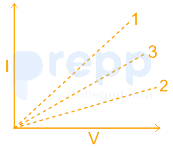
If R 1, R 2and R 3are the resistances of these resistors, then which one of the following is correct?
An electric circuit is given below. V1 = 1V and Resistance R=1000 Ω.
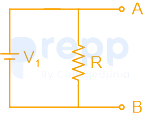
The current through the resistance R is very close to 1 mA and the voltage across point A and B, VAB = 1V. Now the circuit is changed to:
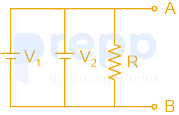
where value of V2 = 5V. The internal resistances of both the batteries are 0.1Ω . The current through the resistance R is about:
A simple circuit contains a 12 V battery and a bulb having 24-ohm resistance. When you turn on the switch, the ammeter connected to the circuit would read
Which one of the following statements regarding Ohm's law is not correct?
Important Questions from Ohm’s Law
Three resistors having resistances in the ratio 1 : 2 : 3 are in parallel. The current through the resistors are in the ratio
Which of the law states that in any closed circuit the current is directly proportional to the voltage, provided the physical conditions of the circuit are kept constant?
According to Ohm’s law, if current (I) increases and potential difference (V) remains constant, then:
Fill in the blank with the most appropriate option.
18 volts = _________ × 3 ohms.
- ______ states that the electric current flowing through a metallic wire is directly proportional to the potential difference ‘V’ across its ends provided its temperature remains the same.



