
(a) Ohm's law states that under all physical conditions, potential difference across a conductor is proportional to the current flowing through it.
(b) Vector form of Ohm's law is $E = \rho j$
(c) Semiconductors do not obey Ohm's law.
(d) Vector form of Ohm's law is $E = \sigma j$
Choose the most appropriate answer from the options given below :
Understanding Ohm's Law and Its Properties
Ohm's law is a fundamental principle in electrical circuits. It describes the relationship between three key electrical quantities for certain materials and conditions:
- Potential Difference (Voltage, V): The electrical pressure that drives current.
- Current (I): The flow rate of electric charge.
- Resistance (R): The opposition to the flow of current.
The basic form of Ohm's law states that the potential difference ($V$) across a conductor is directly proportional to the current ($I$) flowing through it, provided the physical conditions (like temperature) remain unchanged. Mathematically, this is expressed as:
$V \propto I$
Or,
$V = IR$
Where $R$ is the constant of proportionality, known as resistance.
Analyzing the Given Statements about Ohm's Law
Let's examine each statement provided:
Statement (a): Ohm's law states that under all physical conditions, potential difference across a conductor is proportional to the current flowing through it.
This statement is partially incorrect. While Ohm's law correctly states the proportionality between potential difference and current ($V \propto I$), it is only valid under specific conditions, primarily when the physical conditions, such as temperature and mechanical strain, remain constant. If these conditions change, the resistance ($R$) changes, and the linear relationship described by Ohm's law no longer holds accurately.
Statement (b): Vector form of Ohm's law is $E = \rho j$
This statement is correct. Ohm's law can be expressed in a vector form that relates the electric field ($E$) at a point within a conductor to the current density ($j$) at that point. Here, $\rho$ represents the resistivity of the material, which is the reciprocal of conductivity ($\sigma$). The equation $E = \rho j$ is a valid vector representation of Ohm's law, indicating that the electric field is proportional to the current density, with resistivity as the constant of proportionality.
Statement (c): Semiconductors do not obey Ohm's law
This statement is correct. Materials that obey Ohm's law are called 'ohmic' materials, meaning their resistance remains constant regardless of the applied voltage or current (under constant physical conditions). Semiconductors, however, are typically 'non-ohmic'. Their electrical conductivity can change significantly depending on factors like temperature, light, and the applied voltage itself. Therefore, the relationship between voltage and current in semiconductors is non-linear, and they do not strictly follow Ohm's law.
Statement (d): Vector form of Ohm's law is $E = \sigma j$
This statement is incorrect. As established in the analysis of statement (b), the correct vector form relating electric field ($E$) and current density ($j$) involves resistivity ($\rho$) as $E = \rho j$. Alternatively, using conductivity ($\sigma = 1/\rho$), the vector form is typically written as $j = \sigma E$. The form $E = \sigma j$ is dimensionally inconsistent and does not represent the standard vector form of Ohm's law.
Conclusion
Based on the analysis:
- Statement (a) is incorrect because Ohm's law applies under constant physical conditions, not all conditions.
- Statement (b) is correct, presenting a valid vector form of Ohm's law ($E = \rho j$).
- Statement (c) is correct as semiconductors exhibit non-linear electrical behavior and do not obey Ohm's law.
- Statement (d) is incorrect; the vector form involving conductivity is $j = \sigma E$, not $E = \sigma j$.
Therefore, the statements that are correct are (b) and (c).
Important Questions from Ohm’s Law
- ______ states that the electric current flowing through a metallic wire is directly proportional to the potential difference ‘V’ across its ends provided its temperature remains the same.
- _____ states that the electric current flowing through a metallic wire is directly proportional to the potential difference 'V' across its ends provided its temperature remains the same.
The graphs between current (I) and voltage (V) for three linear resistors 1, 2 and 3 are given below:
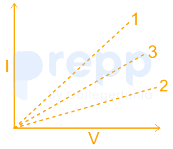
If R 1, R 2and R 3are the resistances of these resistors, then which one of the following is correct?
An electric circuit is given below. V1 = 1V and Resistance R=1000 Ω.
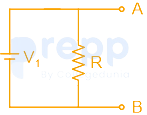
The current through the resistance R is very close to 1 mA and the voltage across point A and B, VAB = 1V. Now the circuit is changed to:
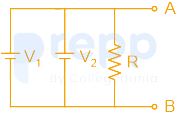
where value of V2 = 5V. The internal resistances of both the batteries are 0.1Ω . The current through the resistance R is about:
A simple circuit contains a 12 V battery and a bulb having 24-ohm resistance. When you turn on the switch, the ammeter connected to the circuit would read


